
The 11-meter boat category might typically suggest a mid-range market product, designed and built for wide distribution, with production and material choices optimized to be accessible to a broad audience. Epica 33, on the other hand, aims higher, without dismissing the market segment it belongs to.
The new shipyard Epica Yacht seeks to offer something extra—an added value that can appeal to higher-end owners while also giving more value to boaters in the mid-to-lower range. Notably, even though this boat has an overall length of 10.90 meters, its hull measures 9.99 meters, classifying it as a vessel that doesn’t require registration.
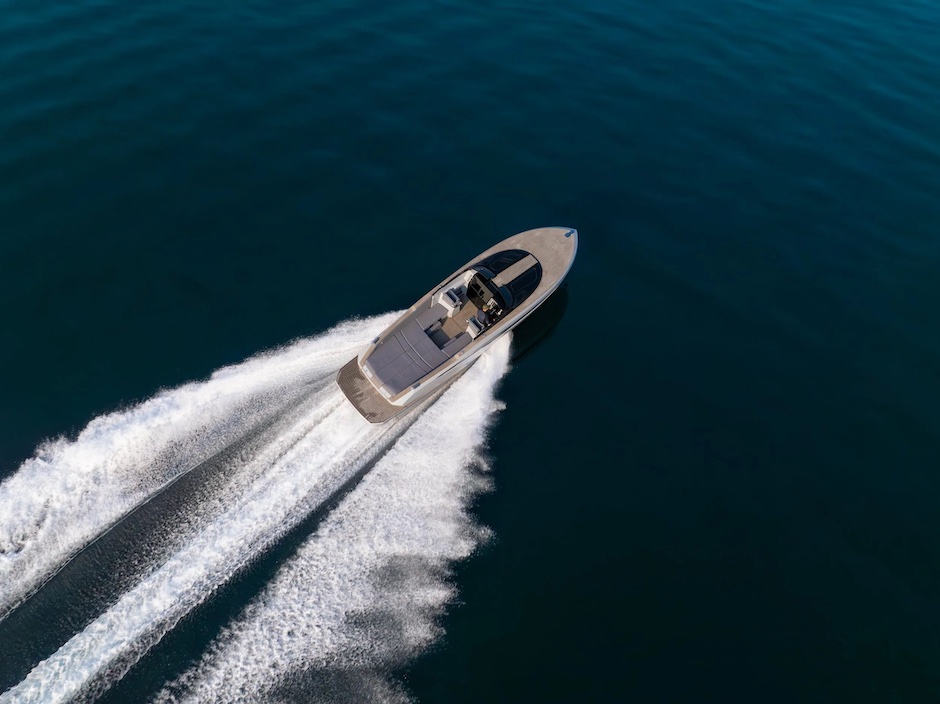
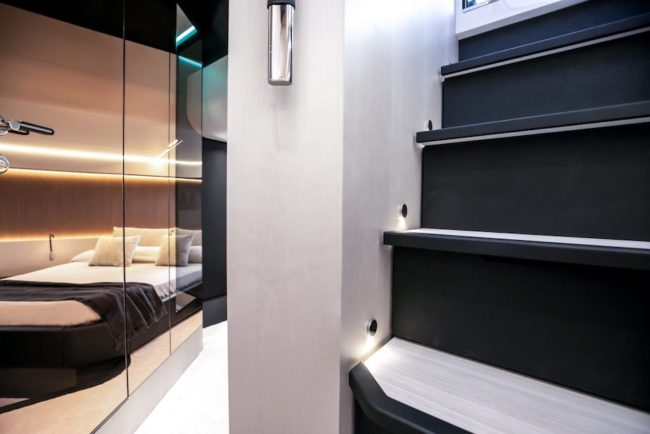
The Epica 33 features high-end construction solutions, refined finishes, and thoughtful details—such as the self-supporting ladder to access the foredeck, with retractable steps built into the inner bulkhead next to the companionway, which itself is made of glass with a steel frame.
Another distinctive feature that highlights the quality at the core of the project is that all the furnishings are structural elements of the boat. This means reduced vibrations and noise in the below-deck area, as well as fewer chances of breakage over time—especially considering that boats don’t always travel on smooth surfaces.
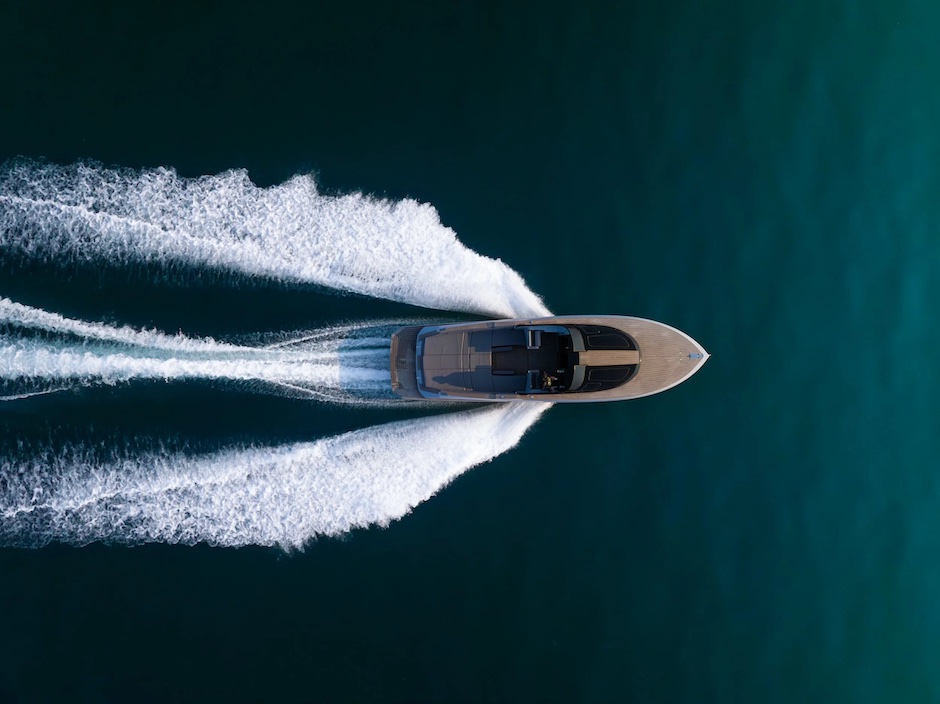
The design is by Marino Alfani, which already speaks volumes about the refined styling and attention to detail. A designer with many innovative boats in his portfolio, Alfani has once again managed to create a boat that remains closely connected to its reference type—in this case, a motorboat—while working on lines, details, and curves that, in the case of the Epica 33, give it the identity of a boat of the future. At the same time, it stands as a design object in its own right—something to be appreciated even beyond its function as a boat.
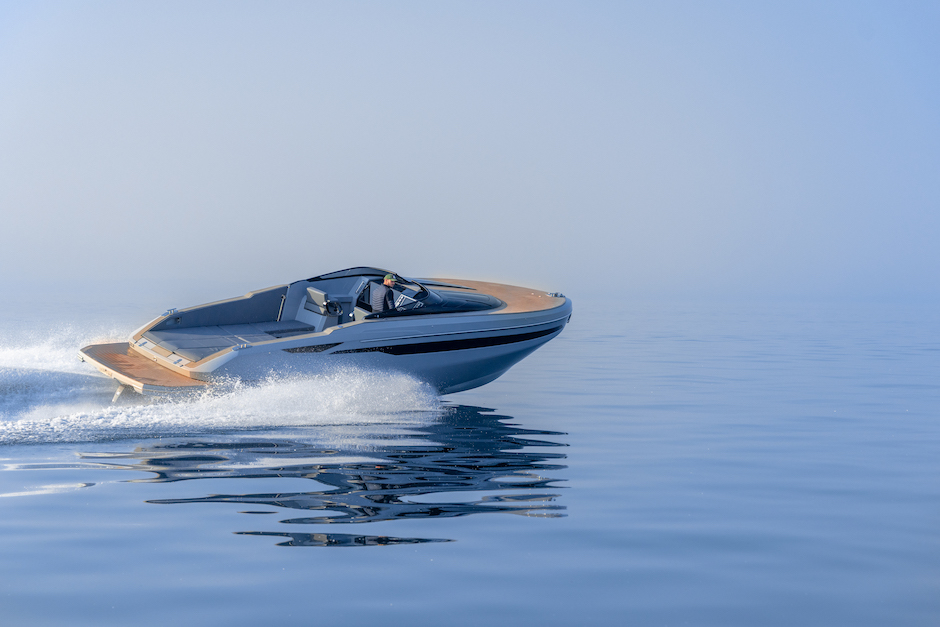
On board the Epica 33
All of this stems from the vision and goals set by the founders of Epica Yacht when launching the shipyard: to build boats that exceed every expectation of their target market segment—from style to comfort to technical content.
As for the technical aspects and performance, we’ll be able to share more soon once we have the chance to test it ourselves. In the meantime, we can rely—both you and us—on what we see: the boat clearly stands out with its undeniable originality in both style and design. And when it comes to comfort, the yard makes no compromises.
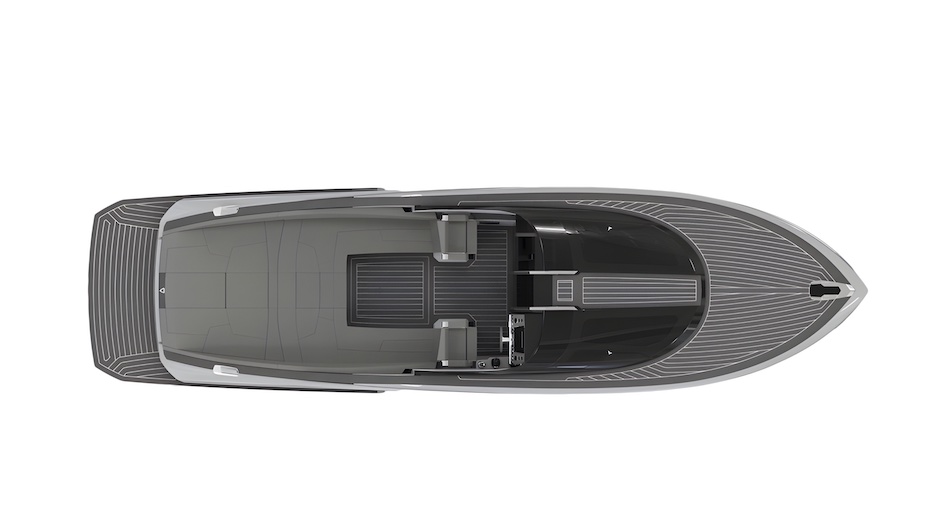
A clear example of this is the choice not to include the classic aft cabin tucked beneath the cockpit. On a boat with such sleek and sporty lines, this space would often offer two berths that are more "nominal" than truly usable in any comfortable way.
The cabin below deck
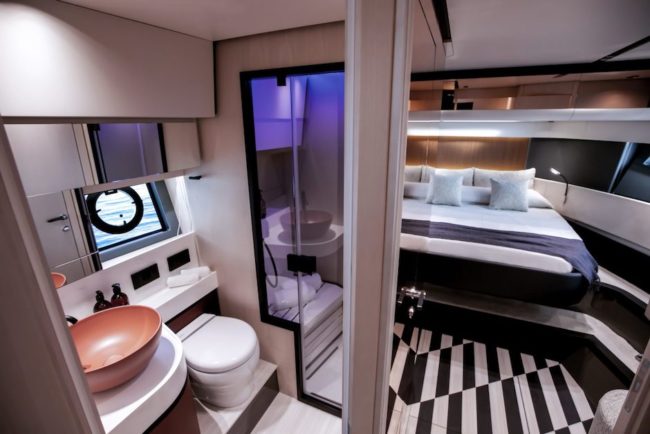
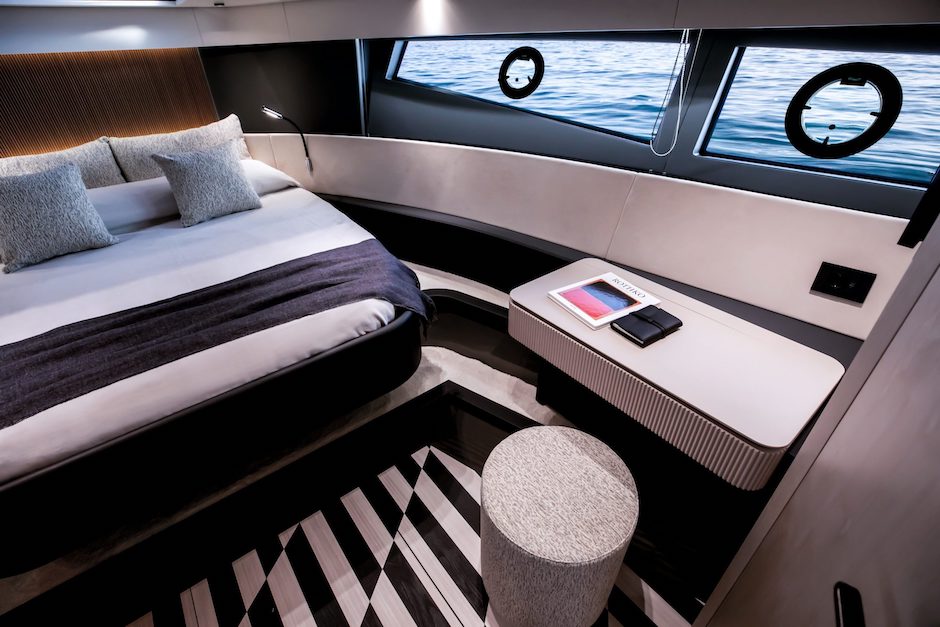
Staying on the lower deck, the cabin height measures 1.85 meters, making it comfortably accessible for most people. To maintain ease of movement, the layout includes only a forward double bed and a galley unit to starboard, along with various storage compartments that don’t add unnecessary bulk.
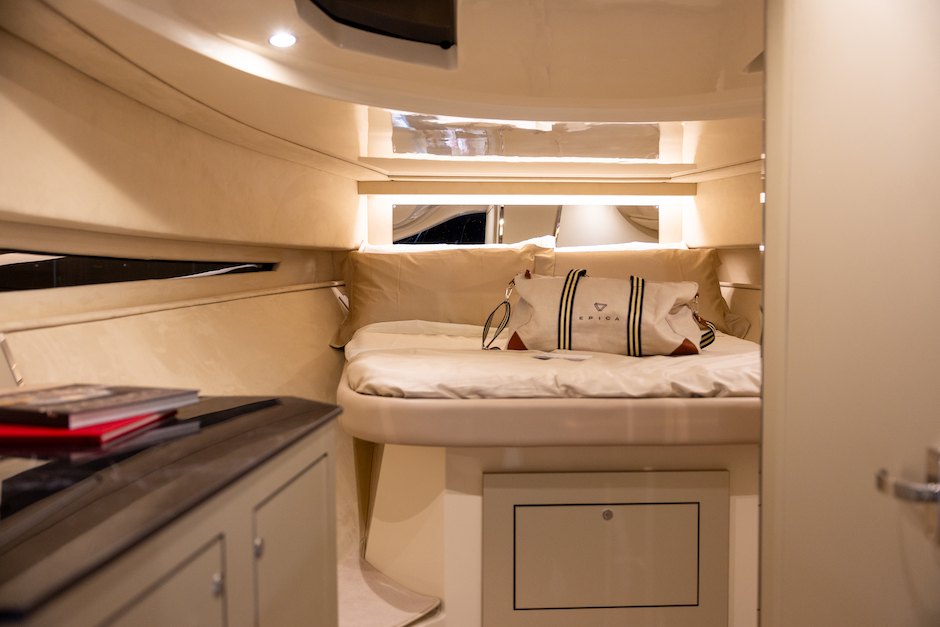
Naturally, there’s also a bathroom in a separate compartment, featuring a dedicated shower and the same 1.85-meter ceiling height.
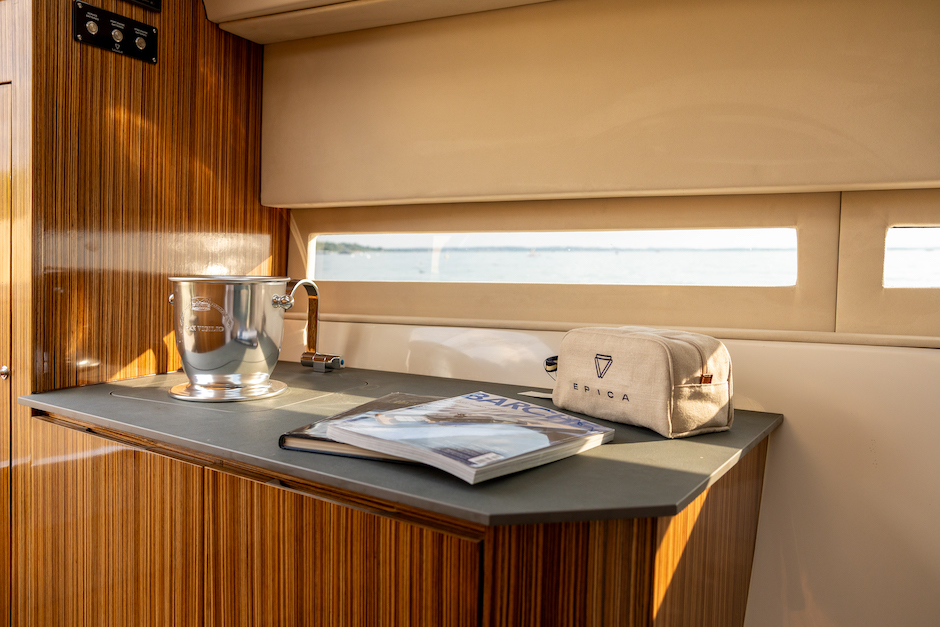
The finishes appear to be of high quality, with furniture and bulkheads featuring a polished, grooved finish that matches the tones of the beige fabric coverings on the remaining bulkheads, effectively eliminating any exposed fiberglass. In keeping with this approach, the flooring is also finished in teak.

Main Deck
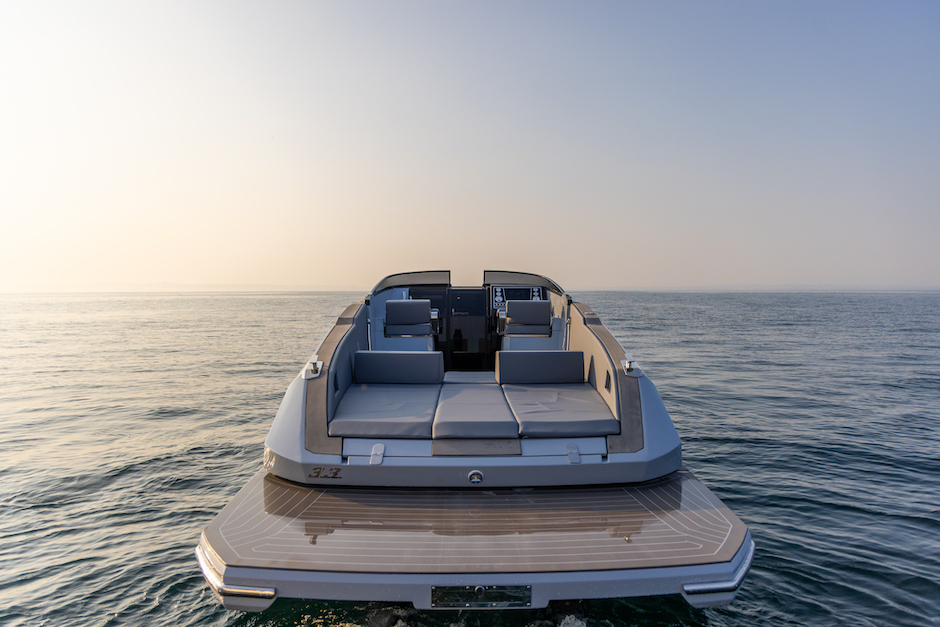
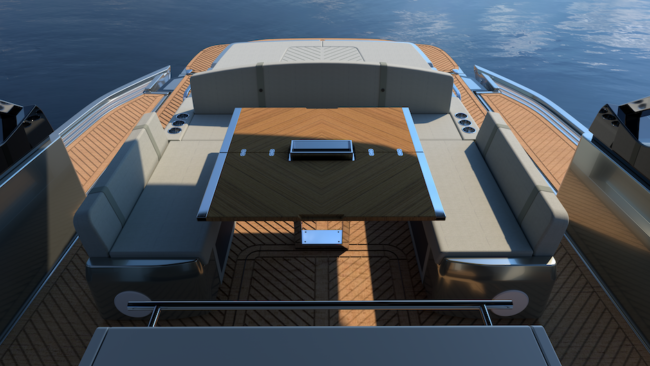
The main deck of the Epica 33 reveals an expansive cushioned area, thanks to the aft sunpad, which is divided into two separate cushions but can be extended full-beam by adding a dedicated insert over the central walkway.
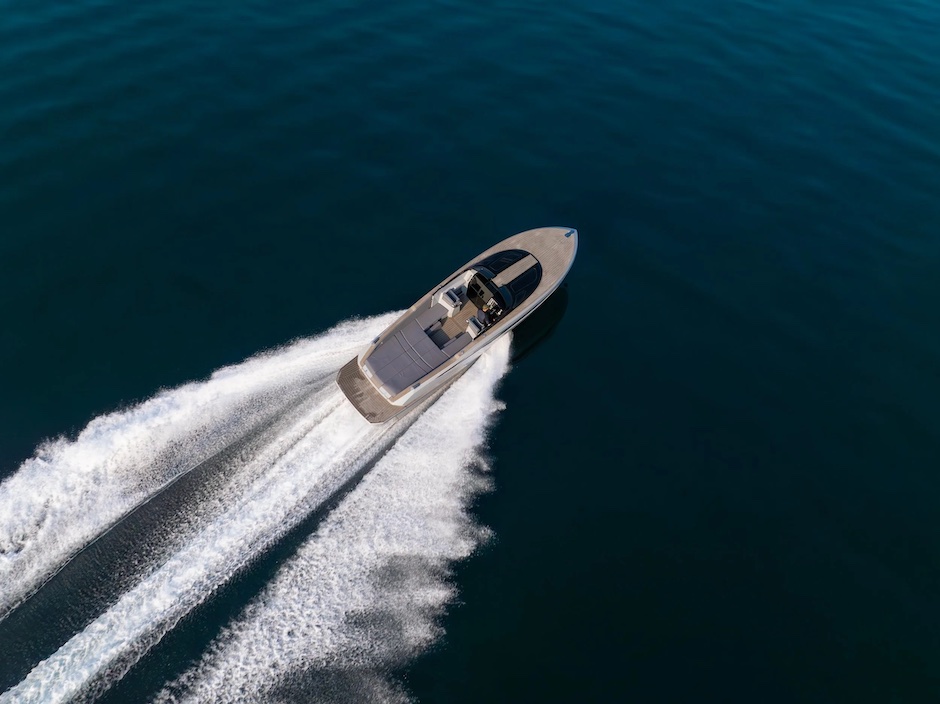
Seamlessly integrated into this space is a C-shaped sofa facing the cockpit, with a forward-facing aft seat and two additional side seats running along both bulwarks up to the helm and co-pilot chairs.
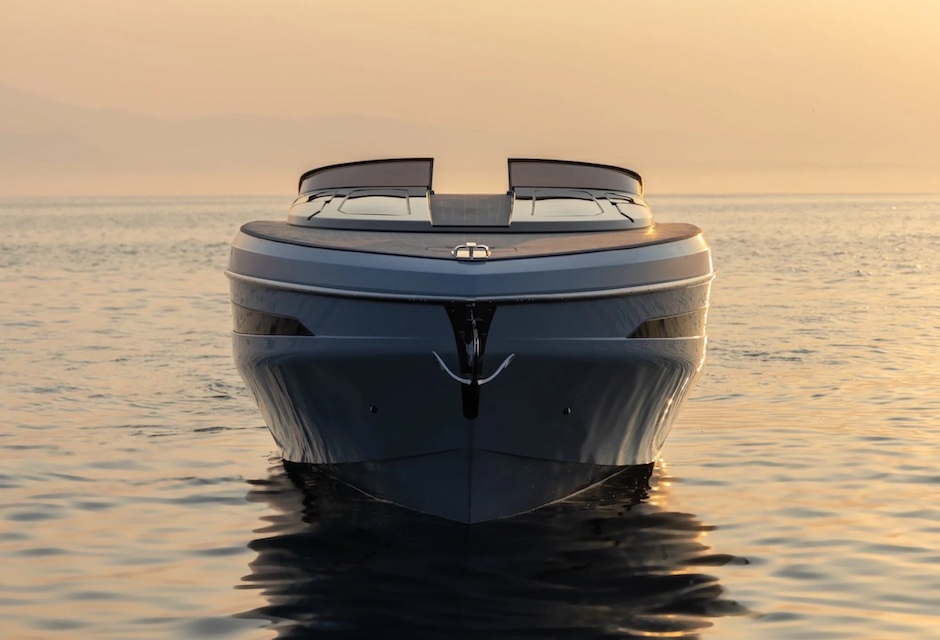
The windshield connects visually with the two large skylights set into the foredeck, increasing the natural light below deck while creating the optical effect of a single, continuous windscreen that stretches almost to the bow.
On deck, too, all flooring and the large aft swim platform are finished in teak, as is the entire gunwale.
Epica 33: Propulsion and Performance
In terms of performance, the recommended engine setup for the Epica 33 consists of twin Volvo Penta V8 sterndrive engines, each producing 350 hp. According to the shipyard’s tests, this configuration delivers a top speed of 44 knots.
That peak suggests a solid range of cruising speeds, with comfortable performance even at more economical cruising levels.
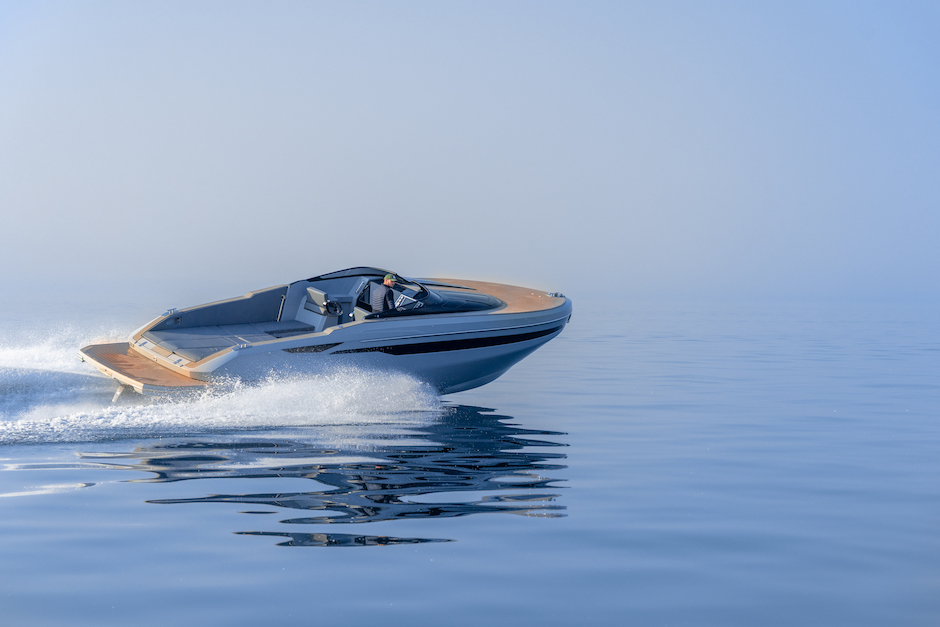
Buyers can choose to go for lower power—or higher. The power range this 11-meter boat can handle goes from a minimum of 2 x 300 hp to a maximum of 2 x 420 hp, always with sterndrives.
Who knows—an outboard version might show up in the future.
A new shipyard with veteran founders—and the range is already set to grow
Epica Yacht was founded in 2024 by three friends: Matteo Jaehnert, Giorgio Colombi, and Alessandro Manenti. All three come from families with a long-standing presence in the boating industry.

Matteo Jaehnert represents the third generation of Nautica Modena, a company founded in the 1950s on Lake Garda. For years, he has managed the commercial side of the various brands his company distributes.
Giorgio Colombi was also born into a family of nautical entrepreneurs and represents the second generation. His father founded Cantieri di Sarnico in the 1990s, and today the family is involved in a separate business focused on custom-built boats for both military and recreational use.
Alessandro Manenti, on the other hand, comes from the accessories sector. His family has been producing high-quality components for both large and small Italian shipyards for generations. He oversees production and design details and also provides consulting services to the shipyards.
This strong mix of expertise led them to create their own boatbuilding company with the ambitious goal of producing vessels with added value—starting with the Epica 33, which is the first model in a wider range.
Several new models are already in the pipeline, all fully customizable, ranging between 27 and 38 feet (8 to 11.5 meters). At least a few names are already known: Epica One, Epica 30 Spider, and Epica 38 T. A T-Top version of the Epica 33 is also in the works.
Epica 33 - Technical Details
| Length overall | 10,90 m |
| Length hull | 9,99 m |
| Beam | 2,95 m |
| Displacement (empty) | 5.800 kg |
| Fuel | 400 l |
| Engins | 2x300 min. - 2x420 cv max |
| Persons | 10 |
| Designer | Marino Alfani |
Click and enter the official Epica Yacht's website
With over 50 years of experience in day cruisers and open boats, the Michigan-based shipyard from Cadillac, owned by Beneteau, is branching into cruising with a new line of vessels, of which the Four Winns TH36 is the first model.
It measures 11 meters in length and 3.66 meters in width, offering a sporty character in a cabin-equipped catamaran format, emphasizing onboard space and practicality.
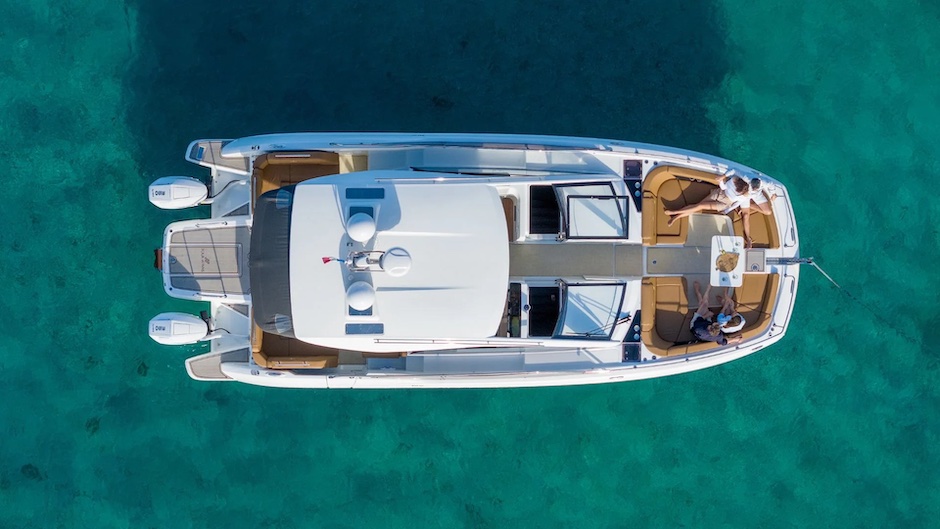
One standout feature of this multihull is its width, which is not significantly greater than that of a monohull of similar size, ensuring no major complications regarding marina berthing space.
It also benefits from the hydrodynamics of the two hulls, which allow for greater speed with reduced fuel consumption, thanks to the lower resistance of the wetted surface on the water.
The Four Winns TH36 can accommodate up to 15 people, four of whom can stay overnight, and is powered by two outboard engines, each with a power range from 300 to 350 hp.
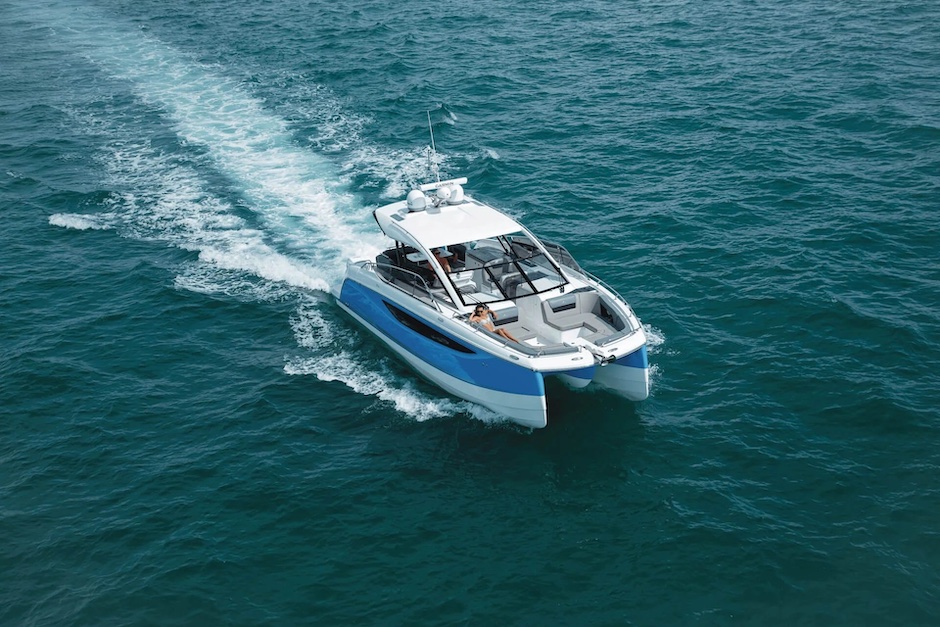
Sophisticated design on the Four Winns TH36 to provide ample onboard space, even at night
For the design of this 11-meter catamaran, the shipyard entrusted specialist Marc Lombard with developing the multihull structure and the Italian studio Garroni Design for the aesthetics, inspired by Four Winns' HD (Hybrid Deck) line of boats.
The sleek upper profile closely resembles the look of speedboats, while the forward cockpit on the deck recalls the design of bowriders.
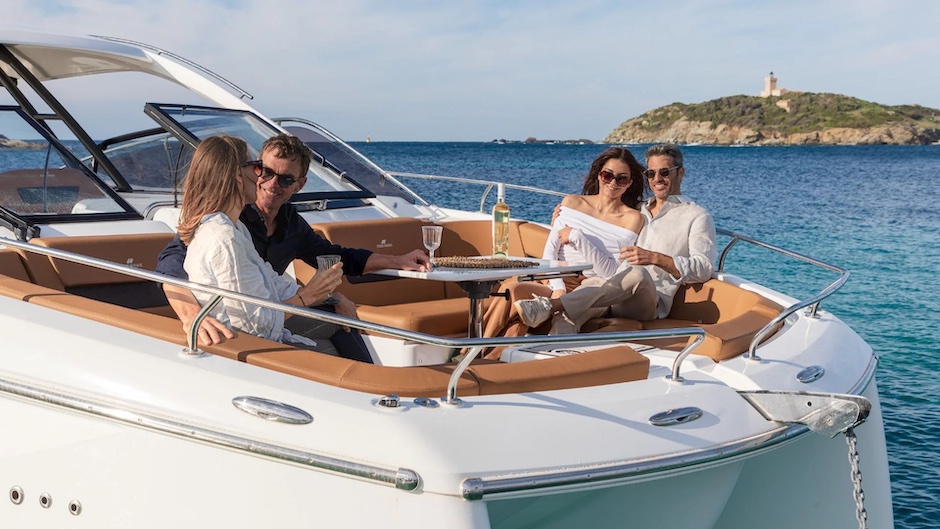
The result is a catamaran with a pure sporty design that is also comfortable for everyone. Space on board is plentiful: the forward cockpit alone can accommodate six people, while the rest of the open-space deck, largely sheltered by a hardtop, is well-organized.
Behind the helm station, in a very spacious cockpit, there are three sofas, including two corner dinettes, as well as a large kitchen unit.
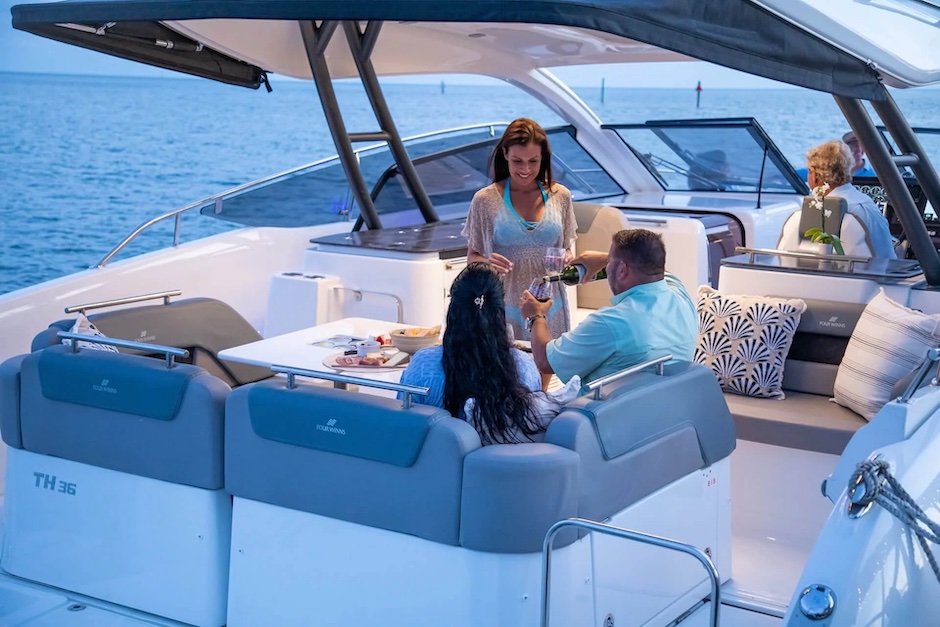
In addition to the galley, there's also a barbecue on this 11-meter catamaran.
The kitchen area is fully equipped, featuring various compartments for storing items and placing the refrigerator, as well as the sink and stovetop.
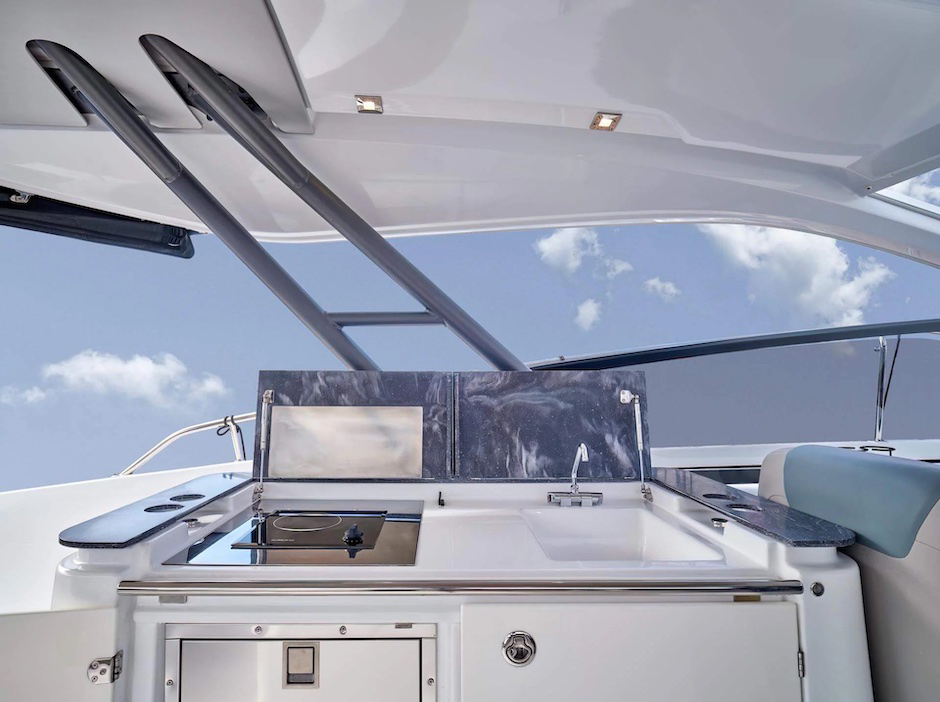
Among the most intriguing optional features is a pure “American-style” barbecue. After all, the ample space on board and the open-air layout of the Four Winns TH36 make it perfect for hosting large barbecues.
Two cabins, four berths like a true cruiser for this 11-Meter multihull
Below deck, the use of two hulls has allowed for the creation of two cabins, each featuring twin beds, wardrobes, windows with curtains, and a bathroom equipped with a separate shower.
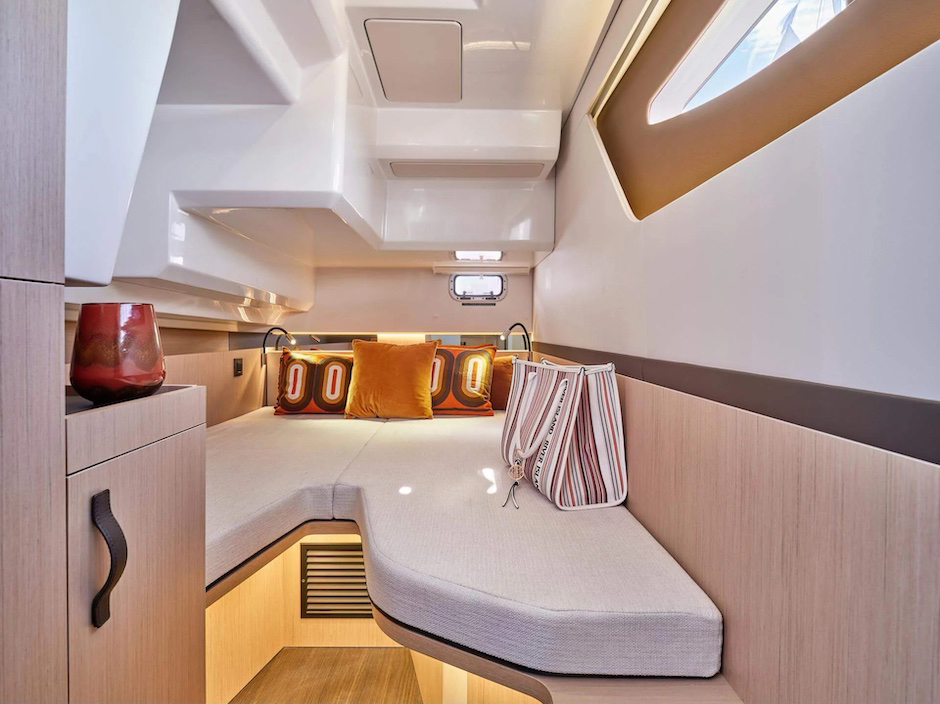
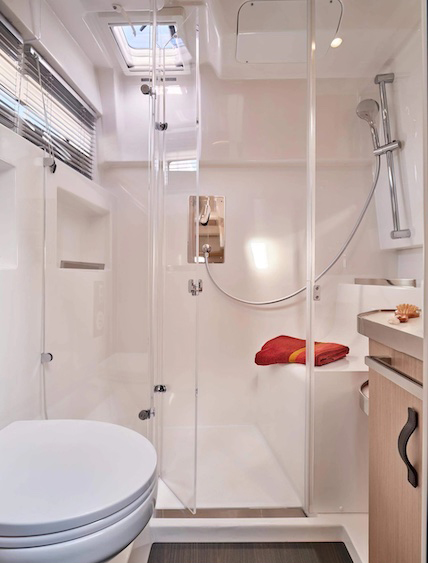
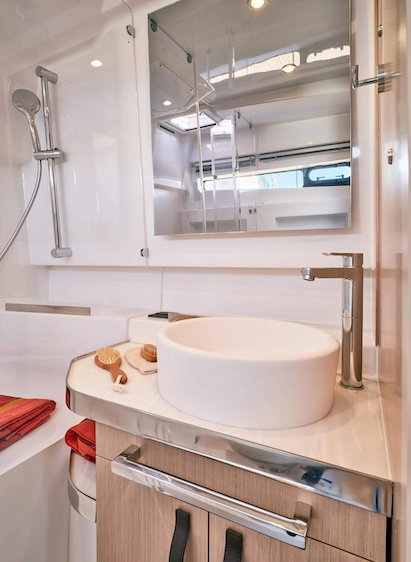
In addition to the below-deck space, the impressive privacy of the two cabins is noteworthy, thanks to their placement in separate hulls.
600 or 700 hp total for the two outboard engines
Designed for navigation both at sea and on lakes, the new Four Winns TH36 is equipped with two outboard engines.
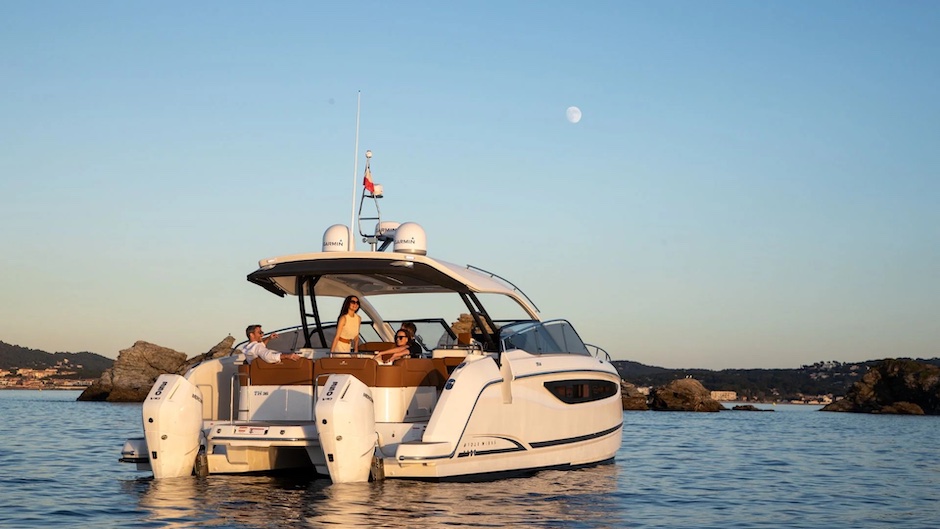
Depending on the performance goals of each owner, you can choose between two 300 HP outboards from Mercury or Yamaha, or opt for maximum available power with a pair of 350 HP engines.
All powertrains are equipped with a joystick, allowing for precise and effortless control of the boat during maneuvers.
Specifications of Four Winns TH36
| Length Overall | 11,71 m | 38'50" |
| Beam | 4,40 m | 14'70" |
| Draft | 0,97 m | 38" |
| Light displacement | 7,237 kg | 15.955 lbs |
| Fuel capacity | 925 l | 244 gal |
| Fresh water capacity | 190 l | 50 gal |
| Engine power (max) | 2x350 hp outboard | |
| Cabin | 2 | |
| Berths | 2 | |
| Certification | B (9 persons) - C (14 persons) |
Discover the full range of Four Winns boats on the shipyard's official website.
Is battery-electric the only solution for more sustainable mobility, both on land and at sea? As you might have guessed, the answer is no.
Theoretically, this is supported by a study from the International Council of Marine Industry Associations (ICOMIA), which states that a multi-layered approach is the best way to continue decarbonizing recreational boating. Practically, this is evident not only in the maritime sector but also in other industries.
Among the most promising alternatives for achieving zero emissions is hydrogen, which can be utilized in two different ways—both of which we will explain in this article.
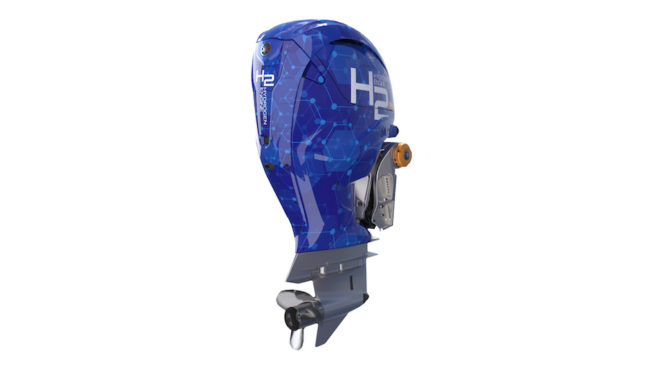

After launching Harmo, their next-generation electric motor, Yamaha has now introduced the first hydrogen outboard motor. Science fiction or reality? Let’s find out.
Hydrogen-powered Outboard: a futuristic project supported by three major companies
Currently, Yamaha's new hydrogen outboard is still a prototype in the development phase, aimed at determining whether it could be a viable solution for the boating industry.
The engine block is being developed in collaboration with Roush (a leading company for nearly 50 years in providing innovative design, testing, prototyping, and manufacturing services across advanced mobility, aerospace, defense, and theme park sectors) and Regulator, a US-based shipyard specializing in offshore sport fishing boats.
About the Yamaha hydrogen-powered outboard engine
Currently, there is no technical information available regarding the power range of the hydrogen outboard. However, a short video released by Yamaha (shown below) clearly features a large V8 engine block. It seems to be from the XTO family, suggesting high performance with power starting from around 400 hp.
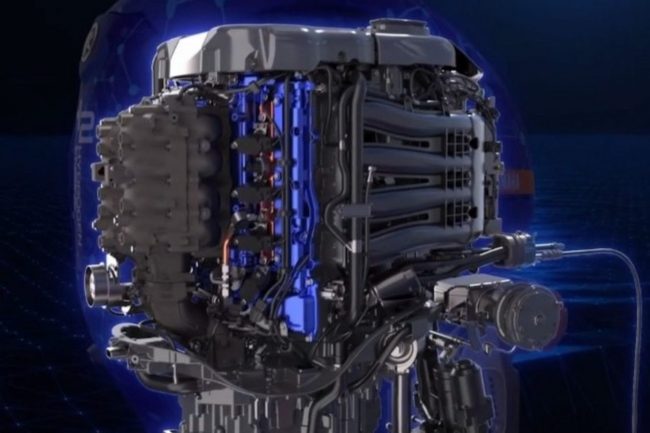
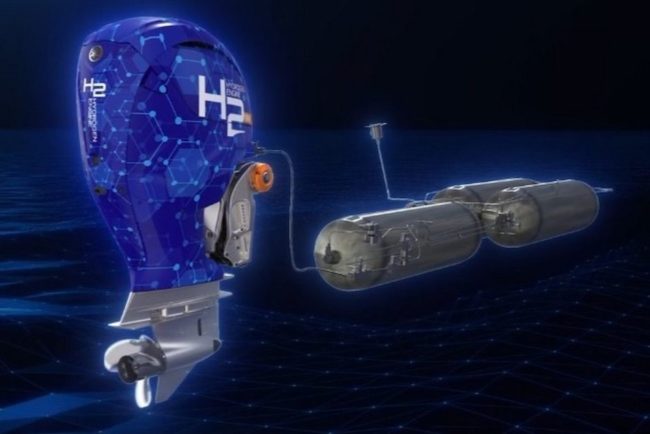
First details also mention the fueling system, leading to the assumption that it involves direct hydrogen injection into the engine. To simplify, this concept is similar to how gasoline is injected into the combustion chamber.
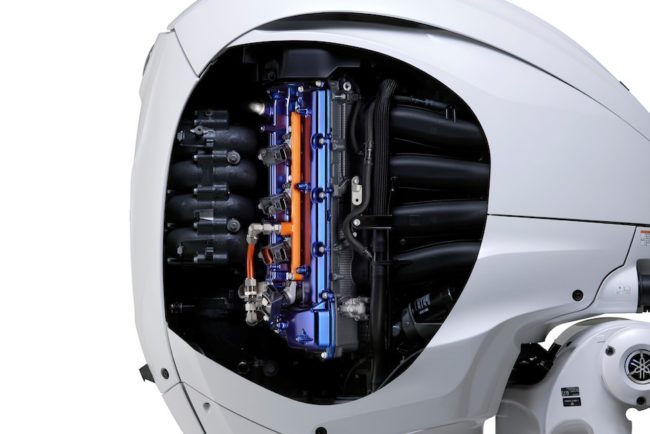
One of the significant advantages of this technical choice is that by utilizing the structure of a traditional engine, only a few mechanical modifications are necessary to gain the benefits of clean hydrogen emissions (since hydrogen combustion produces no CO2, but only a small amount of NOx).
The dual pathway of hydrogen: fuel cells and direct injection
Let’s take a brief step back: hydrogen can be utilized in two ways. The first, more commonly known in the automotive world (with models like the Toyota Mirai relying on this technology), is hydrogen fuel cells.
This process involves hydrogen stored in tanks reacting with oxygen via reverse electrolysis, directly onboard, producing electricity, heat, and water. The electricity generated is then stored in small batteries and used to power an electric motor that provides propulsion. In this case, the vehicle can be considered electric.
The second method uses hydrogen as a fuel injected directly into the engine, which, as with current combustion engines, consists of pistons, connecting rods, valves, and other components.
In the motorcycle industry, this system is already being discussed: Yamaha, in collaboration with other Japanese giants (Kawasaki, Suzuki, and Honda), is developing a hydrogen direct injection engine.
The first prototype, called the Ninja H2 HySE, has already taken shape. Yamaha has also developed a 5.0-liter V8 hydrogen engine, with which a Toyota race car completed a 24-hour race at the Fuji circuit.
Hydrogen or battery? The future is approaching
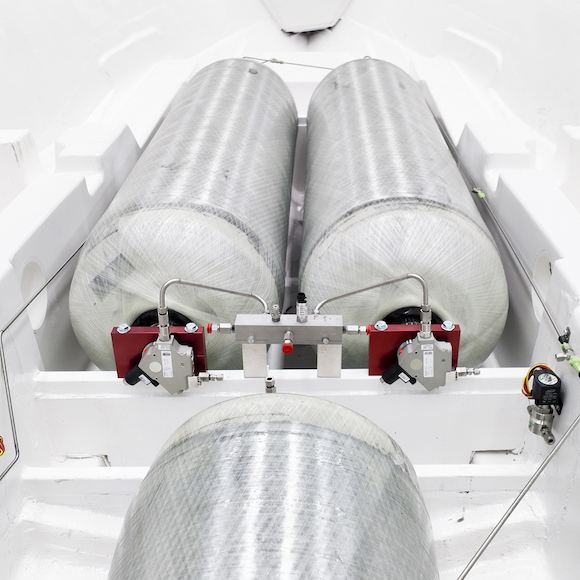
Returning to Yamaha's maritime project, Regulator Marine has already built a hull based on the Regulator 26XO. The main modifications were made to accommodate the hydrogen tanks required to power the new outboard engine.
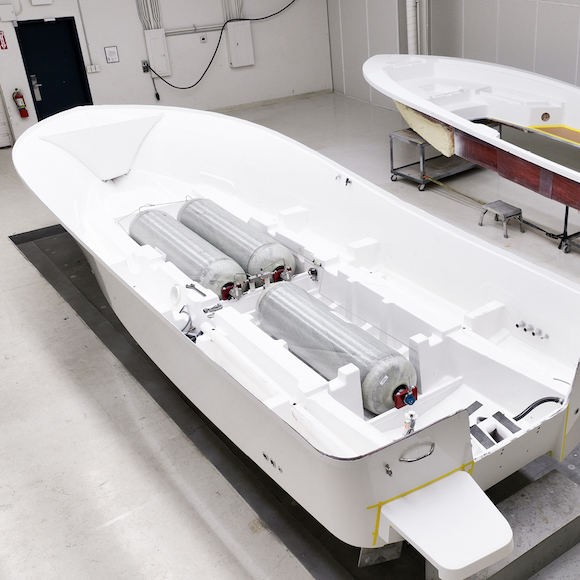
Images show that on this 8.2-meter model, technicians were able to fit three tanks near the keel to achieve the best weight balance.
While the exact amount of hydrogen these tanks can hold is still unknown, considering that the Toyota Mirai stores 142 liters (equivalent to 5.6 kg of hydrogen), which provides a range of 650 km, it’s likely that hydrogen-powered boats could also achieve several hours of navigation, comparable to traditional fuel.
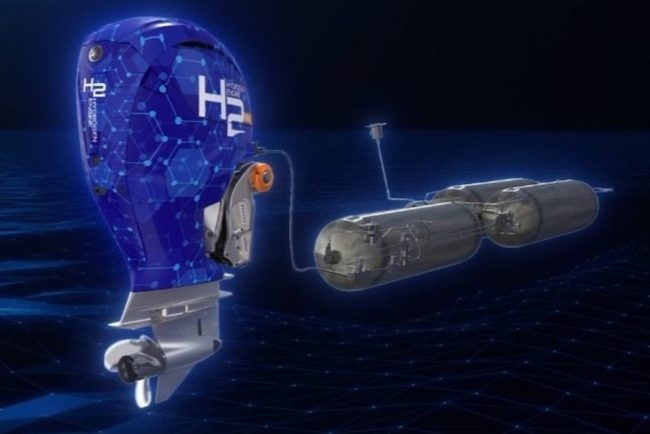
We await further updates on this nautical innovation, which is set to make its debut on the water next summer.
In summer, in fact, further details and developments regarding Yamaha's new hydrogen outboard motor may be announced.
Click here to discover all the products on Yamaha Marine's official website.
While electrification has become the dominant trend in land mobility, the same cannot yet be said for the boating sector.
Though there are undoubtedly opportunities to apply these technologies in yachting, their adoption remains the exception in an industry still largely dominated by internal combustion engines.
However, Azimut Yachts has always been keen to explore new horizons. This is evident in the Seadeck series, the yard’s first range of hybrid yachts. Following the anticipated debut of the Seadeck 6 at the 2024 Venice Boat Show, the series is expanding upwards with the arrival of its new flagship: the Azimut Seadeck 9, set to debut in 2026. Meanwhile, the Seadeck 7 made its premiere at the Cannes Yachting Festival 2024,
Azimut Seadeck 9: reducing emissions to the absolute limit
In addition to the Grande 30M, at the last Cannes Yachting Festival, Federico Lantero, Head of Product Design at the Azimut-Benetti group, announced the arrival of this new 25-meter yacht as the flagship of Azimut's hybrid series.
So, it's not just a boat, but also the symbol of the new “Low Emission” course the brand has embarked on with the Seadeck range.
Read our article and find out more about the Azimut Grande 32M
From a mechanical perspective, the spotlight is on the three Volvo Penta hybrid power units, 1,000 hp Ips1350 each (enough to reach a top speed of 27 knots). The Azimut Seadeck 9 also reflects a construction approach focused on reducing pollution, with the implementation of "green" technologies and specially designed technical solutions.
The shipyard estimates that this could reduce CO2 emissions by up to 40% over a year of average boat use, including both navigation and time spent at anchor.
Human-height windows and an "island" in the sea
Azimut Seadeck 9 is designed by Alberto Mancini with interior design by Matteo Thun & Antonio Rodriguez.
The result is a very modern yacht both in terms of exterior design and interior décor, but special mention must go to the (truly) enormous seamless windows that crown the entire deckhouse, especially the one Azimut calls the “Fun Island”.
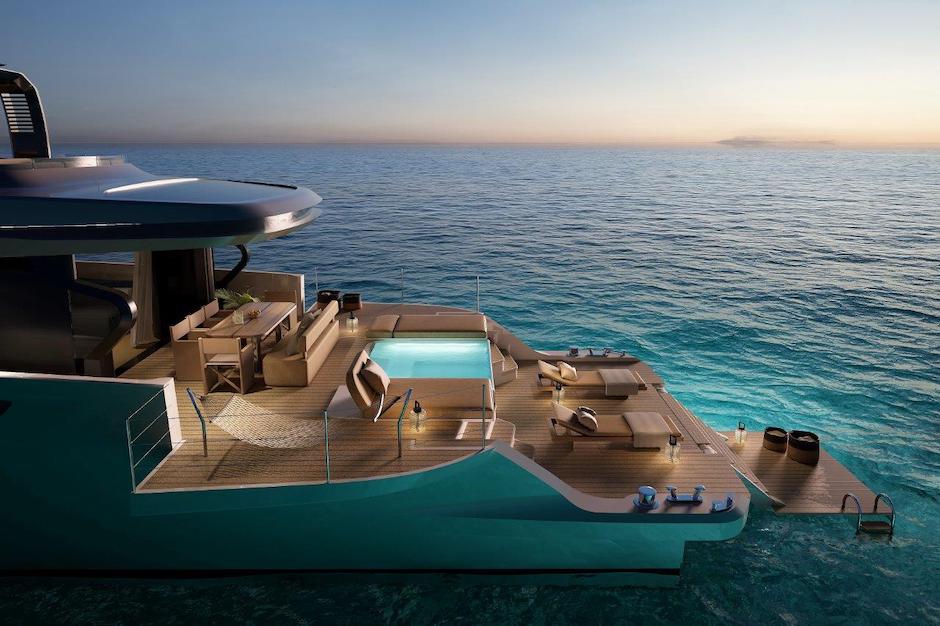
This is an original reinterpretation of the traditional aft space, which brings guests even closer to the sea: a cascade of three terraces on three levels, leading people all the way to the water via a platform with a ladder.
On these 60 m² dedicated to relaxation, there is space for four sun loungers, two of which are placed on the middle beach area, and two more at the far end of the cockpit. The latter are also movable, allowing them to cover the aft pool when needed.
Last but not least, the below-deck layout offers two options: 4 or 5 cabins, plus one for the crew.
The first technical data of Azimut Seadeck 9
| Lenght overall | 25,60 m |
| Engines | 3x1.000 cv Ips1350 Volvo Penta |
| Cabins | 4/5 + 1 Crew |
| Estimated maximum speed | 27 nodi |
Click here to visit the official Azimut Yachts website.
Abundant glass, as much as possible, ensures a direct connection to the sea, allowing guests to fully enjoy the maritime environment even within an enclosed boat. This is the core philosophy behind the design of the new Saxdor 400 GTC.
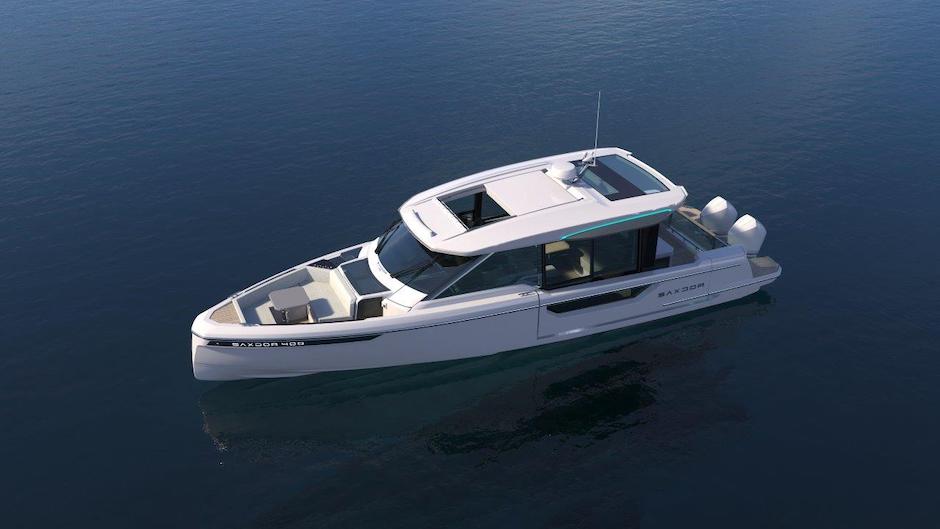
Building on its remarkable growth over the past four years, the Helsinki-based shipyard chose the Düsseldorf Boat Show to unveil the world premiere of this 12.40-meter outboard model, positioned just below the flagship Saxdor 460 GTC.
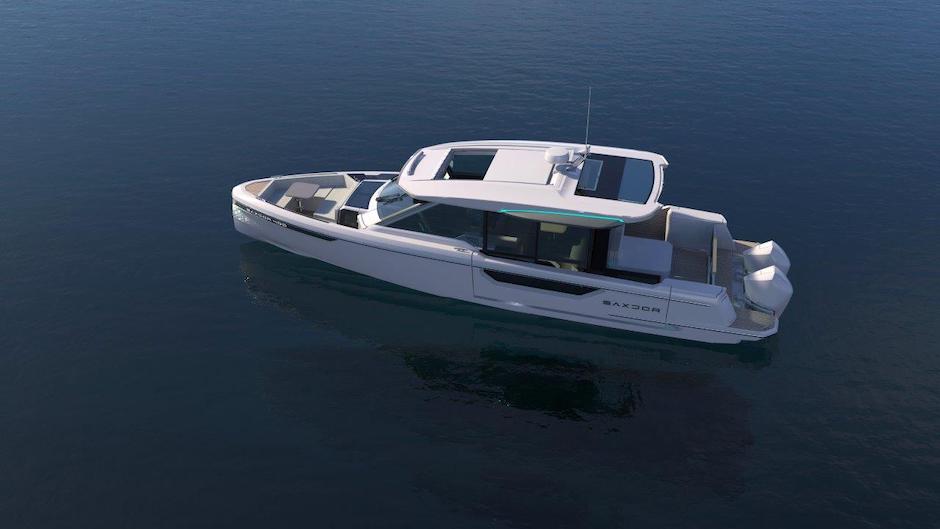
Saxdor 400 GTC, an enclosed yet open yacht
The new Saxdor 400 GTC makes the extensive use of transparent surfaces one of its key strengths, both in terms of livability and design.
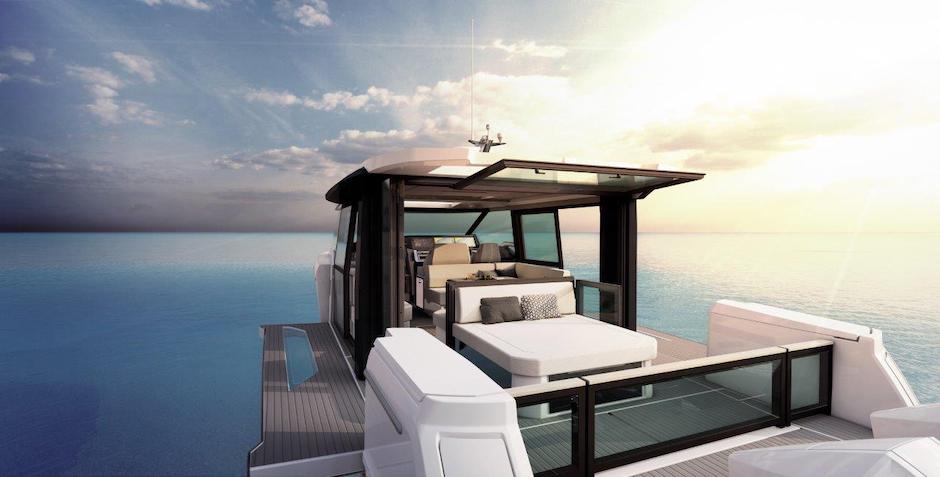
Glass literally surrounds guests inside the salon, with generous glazing extending to the aft section of the superstructure. Multiple opening sections create a seamless connection between the exterior cockpit and the interior salon or, alternatively, allow for a fully enclosed salon.
Deck Layout of Saxdor 400 GTC
The helm station on the Saxdor 400 GTC spans the full beam of the boat, extending to the companionway leading below deck, as seen on the GTO model. It features a cutting-edge dashboard with three large digital displays.
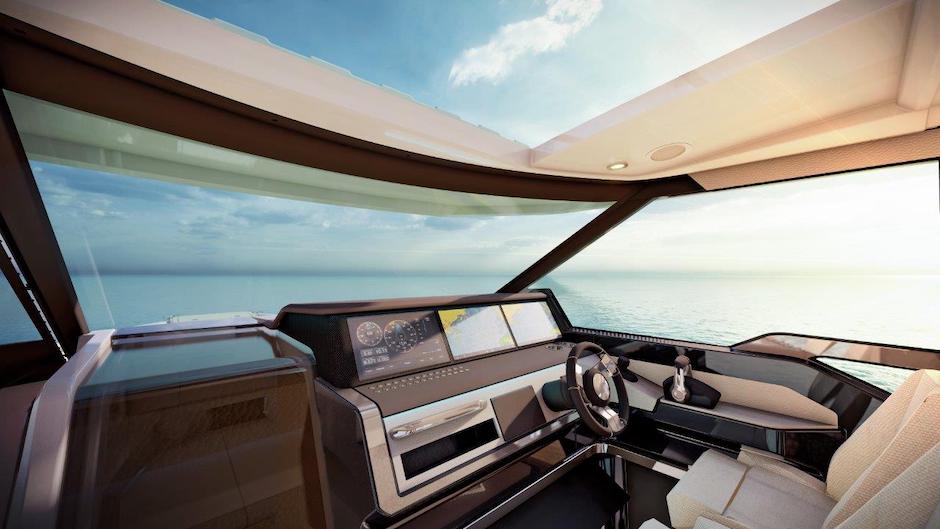
Behind the helm, there’s a well-designed living area with an L-shaped dinette, an aft sofa, and another smaller sofa on the starboard side, where the galley unit is also located.
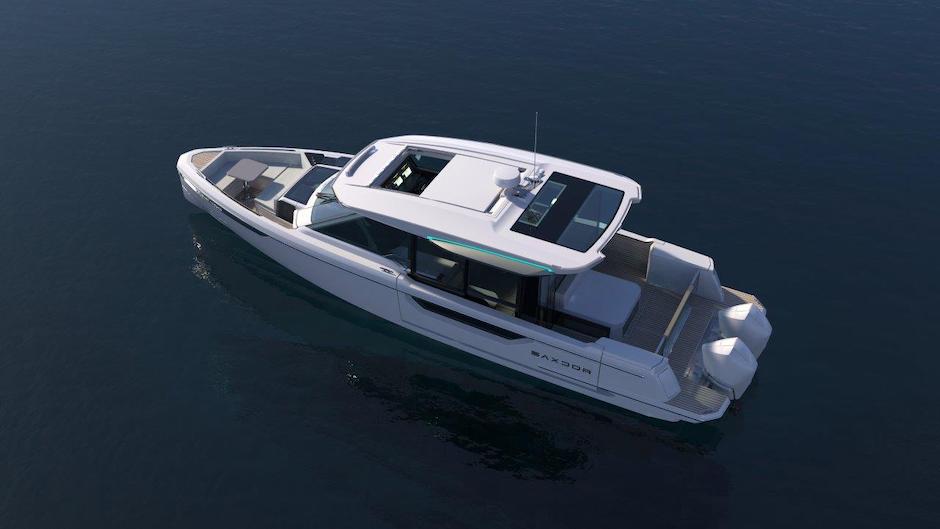
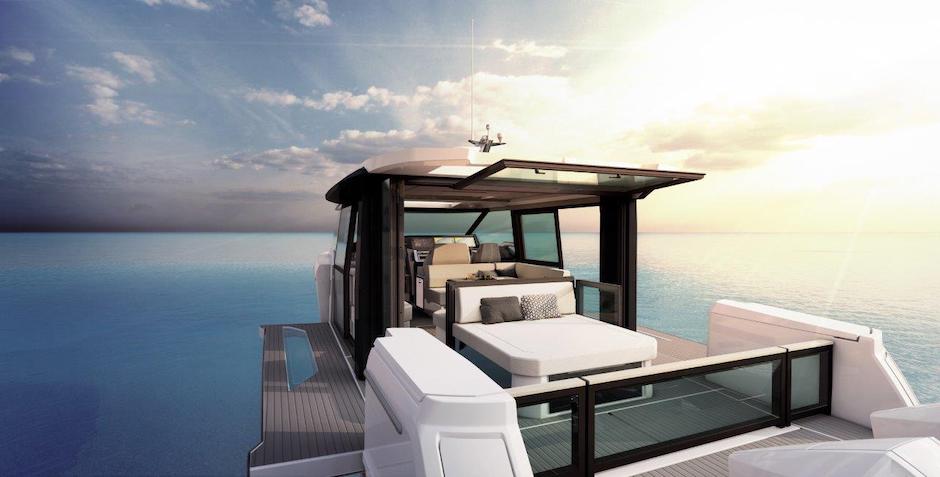
The cockpit offers ample walkable space and includes a semi-sheltered sun pad under the hardtop. At the opposite end of the main deck, in the bow area, there is a second dinette.
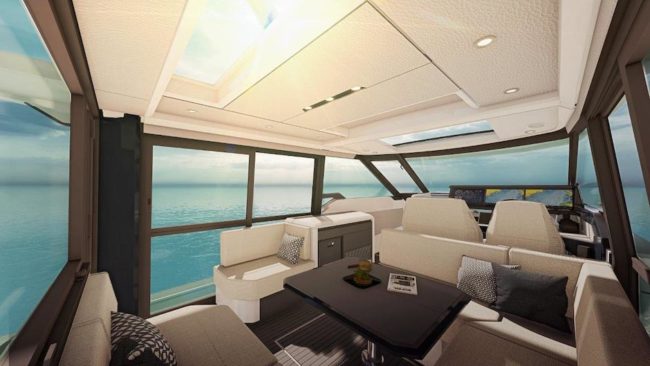
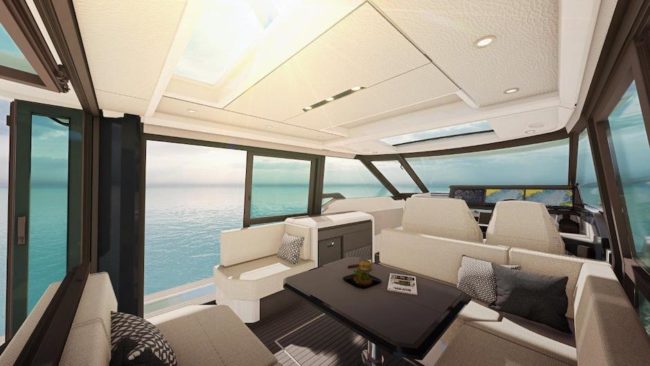
The usable deck space is further enhanced by foldable bulwark sections cleverly integrated into the salon area. With its sliding side glass panels, the salon creates a completely open environment connected to the sea while technically being enclosed within the superstructure.
Even the transom is made of transparent material, providing necessary safety during navigation without obstructing the view of the sea when relaxing on the sun pad.
Below-deck Layout
On the lower deck, the Saxdor 400 GTC is laid out with two double cabins in a classic configuration: the owner’s cabin is located forward, while the guest cabin is aft in a separate, independent area with its own dedicated entrance. Additionally, there is an option to add a third berth, primarily designed for children.
The yacht features a single bathroom, situated within the owner’s cabin area. This layout means that guests staying in the aft cabin must leave their section to access the forward area.
Saxdor 400 GTC: Engines and Price
With the standard configuration of two Mercury V10 350 hp outboard engines, the starting price of the Saxdor 400 GTC is €286,000 (excluding VAT and refers to the 2024 price list).
An optional configuration is available with more powerful Mercury V10 400 hp outboard engines, which can propel the Saxdor 400 GTC to a shipyard-declared top speed of nearly 50 knots.
Both engine setups come paired with Mercury’s JPO (Joystick Piloting for Outboards) system.
Specifications
| Lenght overall | 12,40 m |
| Beam | 3,55 m |
| Draft max | 1,05 m |
| Fuel tank | 1.000 l |
| Water tank | 210 l |
| Waste water tank | 60 l |
| Gray water tank | 105 l |
| Persons on board (max) | 12 |
| Engines | 2x350 or 400 hp |
Click here to visit the official Saxdor website.
As anticipation builds for the Cannes Yachting Festival 2024, early reveals like the FIM 500 Regina provide a glimpse of the exciting innovations coming to the French showcase. This open hardtop yacht now leads both the Regina range and the entire FIM lineup, at least until the FIM 640 Contessa, currently under development, takes its place at the top.
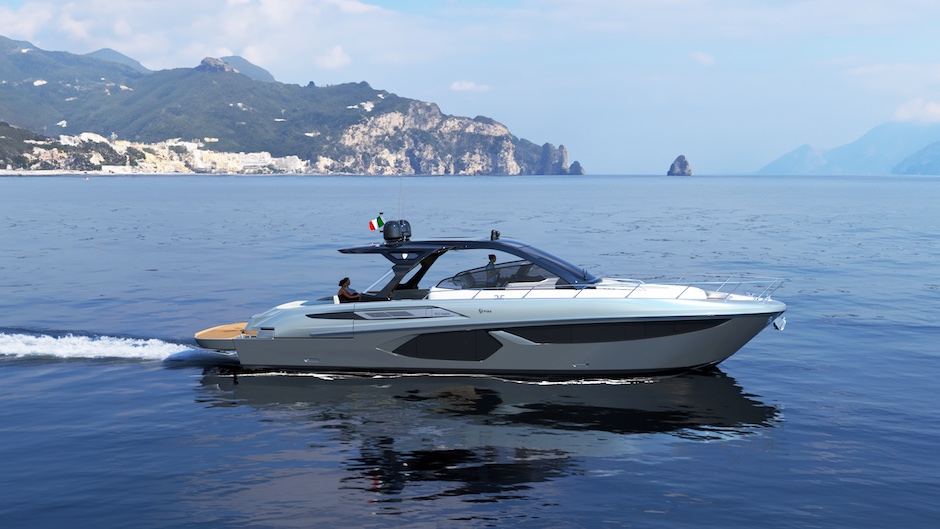
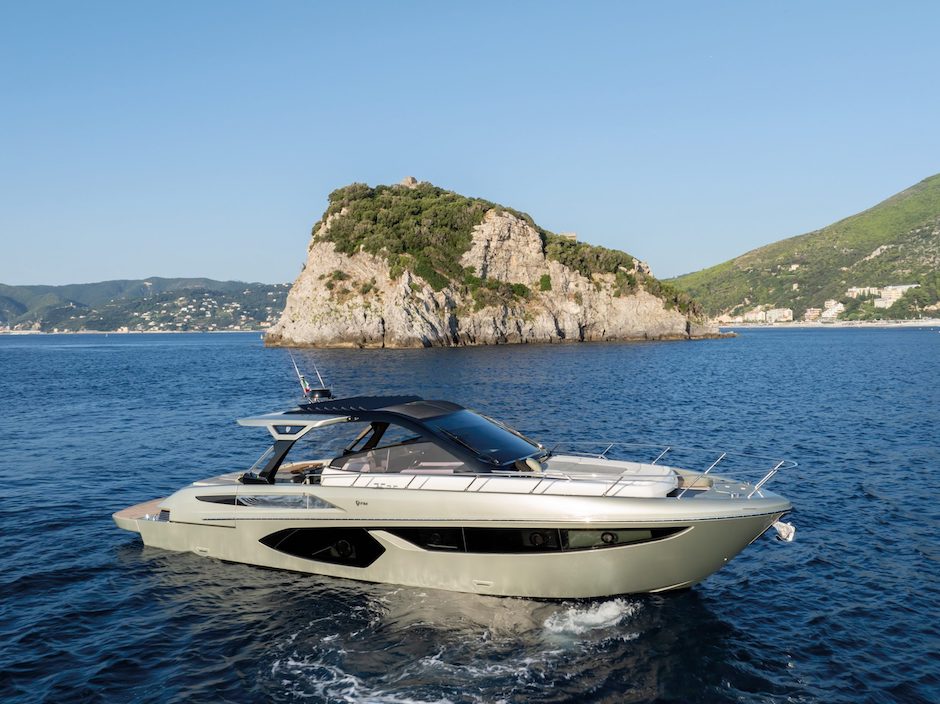
With an overall length of approximately 16.10 meters, the new FIM 500 Regina presents itself as a highly elegant motoryacht. At the same time, it exudes a sporty character through its sleek, streamlined profile a design hallmark evident across the shipyard’s other models. This includes the recently launched 440 Regina.
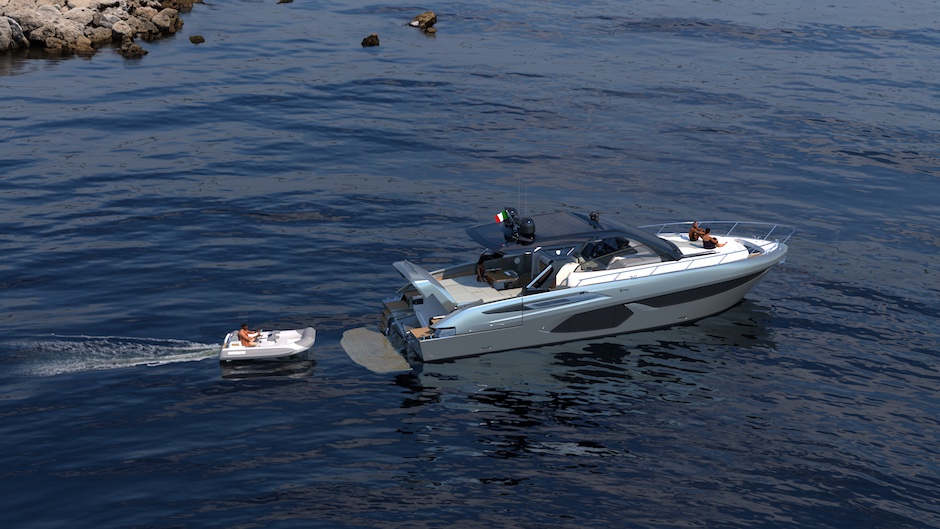
The FIM 500 Regina draws inspiration from the 440 Regina for its distinctive hardtop design. This feature, developed through the partnership between FIM and Design aLOT, defines the yacht's silhouette. Integrated with a sharply angled windshield to enhance aerodynamics and lend a sporty appearance, the hardtop extends dramatically toward the stern. Its open-sided design ensures optimal airflow, delivering a true open-yacht experience.

Among the various innovative options available for the FIM 500 Regina, owners can choose to install photovoltaic panels, contributing to a greener onboard experience. Furthermore, the yacht’s structure is crafted from ultralight infusion-molded carbon fiber, recycled for use in the paneling. This underscores one of the central principles behind the yacht’s design: reducing environmental impact.
More generally, Fabbrica Italiana Motoscafi has sought as much as possible to use durable, recycled, or easily recyclable materials, both inside and outside, including fabrics: for example, the exterior upholstery is made with 100% recyclable materials, with particular attention to ensuring a consistently cool seating experience even in high temperatures.
The below-deck layout of the FIM 500 Regina
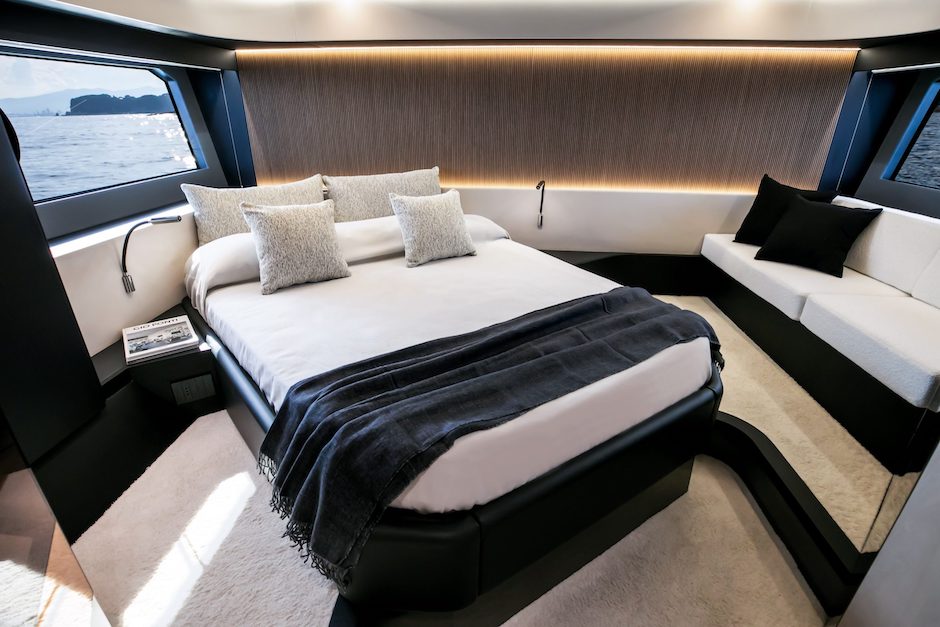
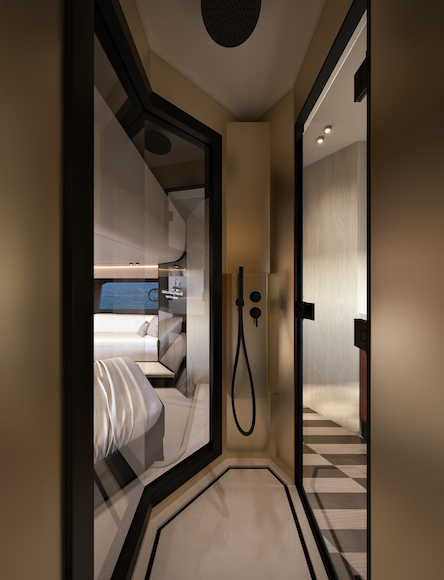
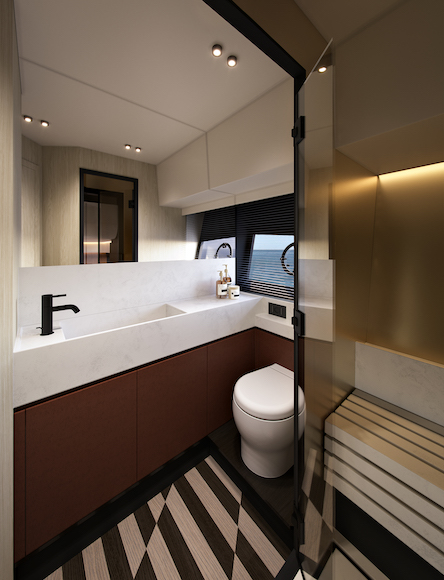
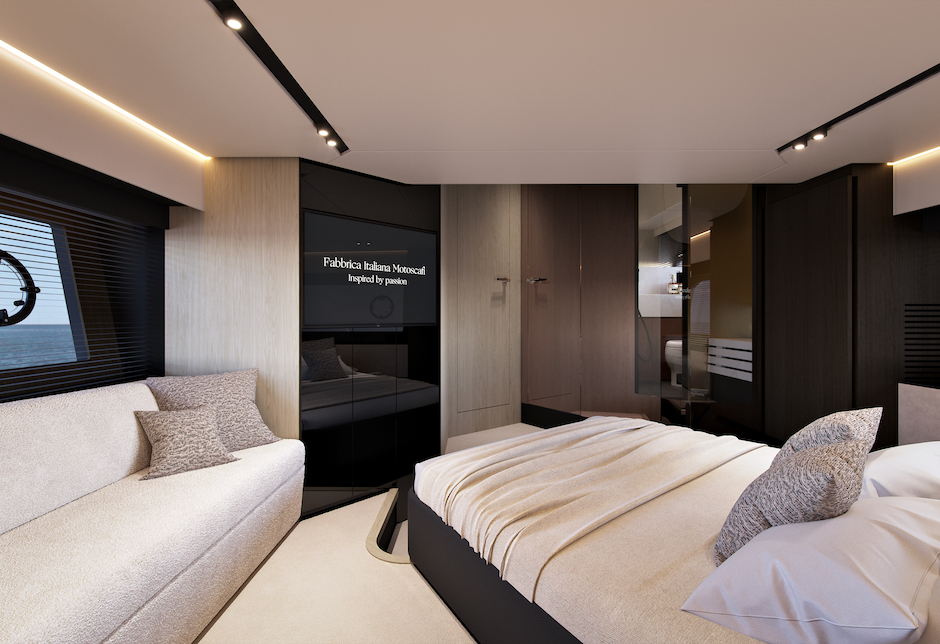
The same sense of comfort and attention to detail can be found below deck, where light abounds thanks to the side windows, the chosen colors, and the interplay of mirrors that characterizes, for example, the bathroom of the owner's suite, which is located aft.
The guest cabin is no less welcoming, offering five-star solutions such as a generously sized walk-in closet and access to a second bathroom with a separate shower box.
Technology and design at the service of guests on deck
FIM has adopted numerous innovative solutions for its flagship. From an aesthetic perspective, the lighting takes inspiration from car design, while the home automation systems put technology at the service of guests and the owner.
Additionally, there are many design solutions that make the outdoor spaces easily adaptable to suit the needs of the moment.
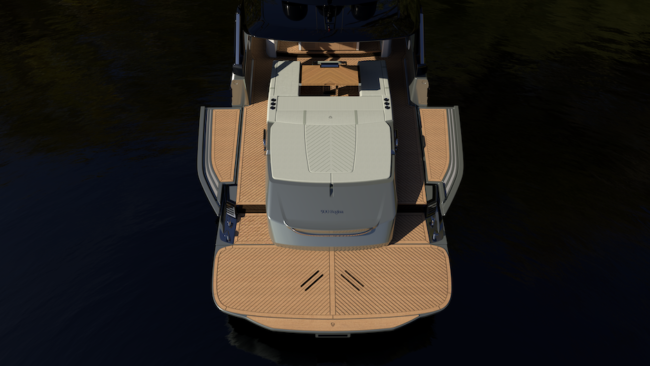
In the cockpit, for example, the sunbed and sofa merge into a single space through a mechanism with folding backrests, while the retractable TV is integrated into a kitchen unit and a console equipped with cameras for assisted mooring.
The entire aft area can also open directly to the sea, thanks to foldable side bulwarks and the swim platform, which is seamlessly connected to the cockpit floor.
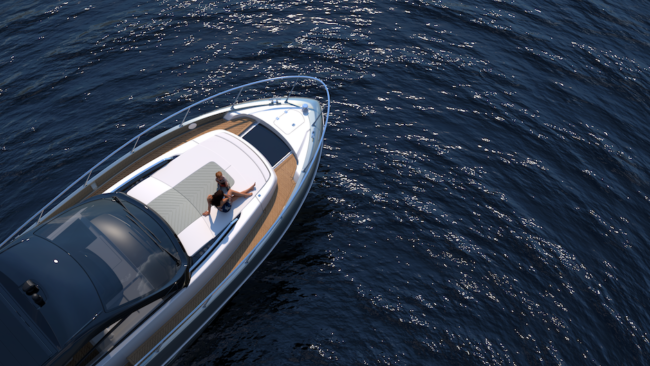
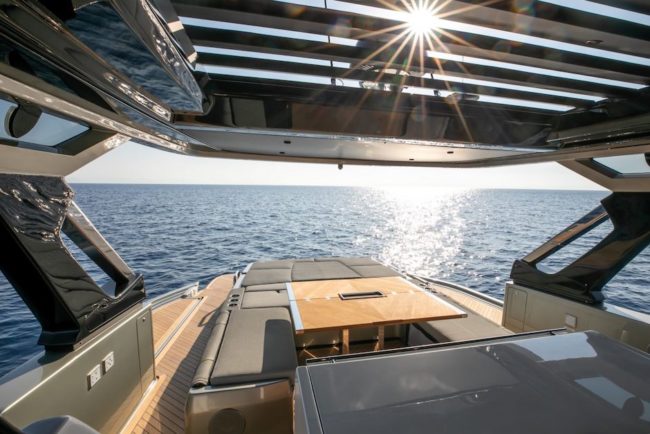
At the bow, a section of the sunbed can be slid toward the bow triangle to transform it into a sofa, creating a lounge area with a separate bench and a central table.
Dual Engine option for FIM 500 Regina
The FIM 500 Regina offers a choice between two engine power configurations: 2x480 HP as standard and 2x600 HP as an optional upgrade.
Regardless of the choice, the engines are always Volvo Penta IPS, specifically the IPS650 in the standard configuration and the IPS800 in the optional setup.

Specifications
| Length overall | 16,10 m |
| Length hull | 14,60 m |
| Beam | 4.40 m |
| Draft | 1,40 m |
| Light Displacement | 17.500 kg |
| Fuel Tank | 2x750 l |
| Water Tank | 400 l |
| Waste water Tank | 60 l |
| Gray water Tank | 80 l |
| Generator | 8 kW Med - 11 kW Top |
| Engines | 2x480 hp Ips650 (std.) - 2x600 hp Ips800 (opt.) |
| Max Persons on board | 16 |
| Certification Ce | Cat. B |
Click here to visit the official FIM - Fabbrica Italiana Motoscafi website.
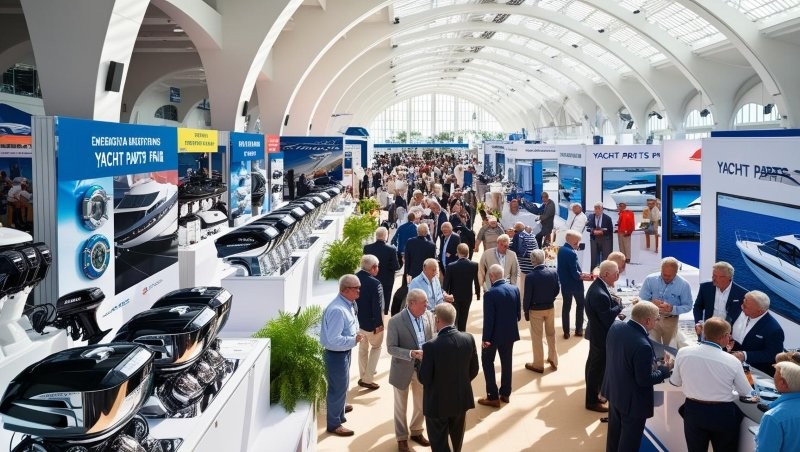
Seaquip – Mediterranean Yacht and Marine Equipment Trade Fair: this is the complete name of the new B2B event created ans organized by the Italian branch of the Easyfairs Group—experts in trade fair organization. Seaquip 2026 is scheduled from March 4 to 6, 2026, at Fiera Milano Rho.
The underlying premise of this event dedicated to industry professionals is simple and impactful: in a country like Italy, a global leader in superyacht production and the second-largest in the world for recreational boating, a key event in the field of components is essential. It provides industry professionals with the opportunity to establish important business partnerships and identify the cutting-edge technologies of tomorrow, ultimately benefiting the end users of these vessels—you, dear readers.
Not by chance in Italy, not by chance in March
While the accessories and components sector already boasts major events—just think of the Mets in Amsterdam—Seaquip 2026 aims to establish itself as a key reference point for the entire Mediterranean region. The timing is particularly strategic for boat manufacturers who, after concluding the global trade fair cycle in autumn and winter, where they showcase their latest innovations, are now focused on the products for the upcoming season.
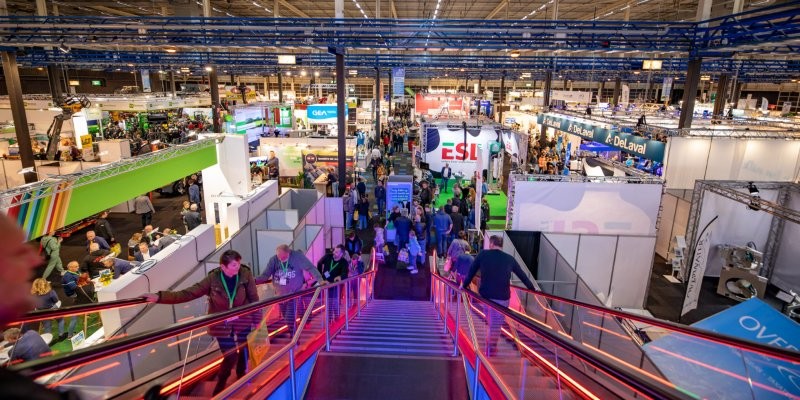
Here, the supply chain of accessory and component manufacturers will have the opportunity to present their latest developments to buyers in Milan, a city that naturally attracts professionals and investors. Moreover, its excellent connectivity from all over Europe makes it an ideal location, especially with Fiera Milano Rho, which is easily accessible via highways, airports, and train stations.
What will draw shipyards, buyers, and suppliers is the well-established organizational expertise of the Easyfairs Group. Managing over 100 B2B trade fairs across Europe, it ranks among the world's top 20 exhibition organizers.
Seaquip 2026: program and exhibitors
Naturally, with a year to go, it is still too early to have precise details on the program for the first edition of Seaquip. However, it is already clear that the exhibition will be accompanied by a packed schedule of conferences, with a strong focus on new technologies and the opportunities offered by artificial intelligence, alternative propulsion systems, and innovative materials.
The forecast is to reach at least 150 exhibitors, if not more. Even with a year still to go, over 50 exhibitors have already confirmed their participation, coming not only from Italy but also from abroad, with a total occupied exhibition space already reaching 1,000 square meters.
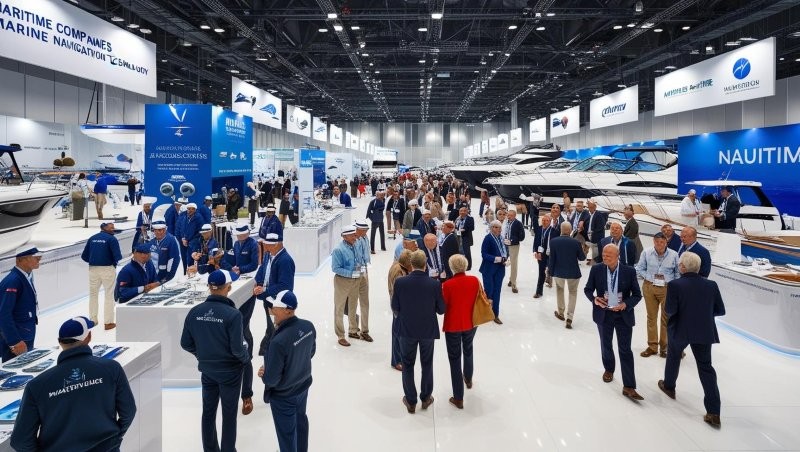
A rapidly evolving event
Raymarine, CMC Marine, Tecnimpianti, Indemar, Opac, and Osculati are just a few of the internationally renowned companies in the marine accessories and components sector that will be present at Seaquip 2026. Meanwhile, the Easyfairs Group reports a continuous influx of inquiries from potential exhibitors and buyers alike, recognizing the event’s potential to foster new partnerships and develop valuable industry networks.

At the same time, the team behind the event is expanding and taking shape. Pier Paolo Ponchia, Managing Director of Easyfairs Italia, explains: “We have brought in highly experienced professionals to anticipate activities as much as possible and structure the project in the shortest time frame”. Here are the key team members:

Paola Tamburini, Customer Success Representative: With 25 years of experience at Fiera Milano Group and a media company, she specializes in creating connections and growth opportunities for exhibitors.

Julian Aguilar, Digital Marketing Specialist: An expert in SEM, SEO, and social media, with over eight years of experience in online marketing strategies and a strong background as a professional videomaker.

Giorgia Costanzelli, Community Activator: With a solid background in marketing and communications at BolognaFiere Group and international exhibition companies.
On board Telli, the Custom Line Navetta 38, the total living space is impressive—around 465 square meters! That’s about the size of a pretty spectacular villa with expansive terraces. (Just for reference, the Ferragni/Fedez villa for sale on Lake Como is about 470 square meters.) The difference? Instead of being surrounded by a garden, Telli is embraced by an endless sea.
The master suite spans 40 square meters—just a couple of square meters smaller than the salon that precedes it on the main deck. Meanwhile, the aft outdoor area, which includes the beach club and cockpit, extends to a generous 70 square meters.
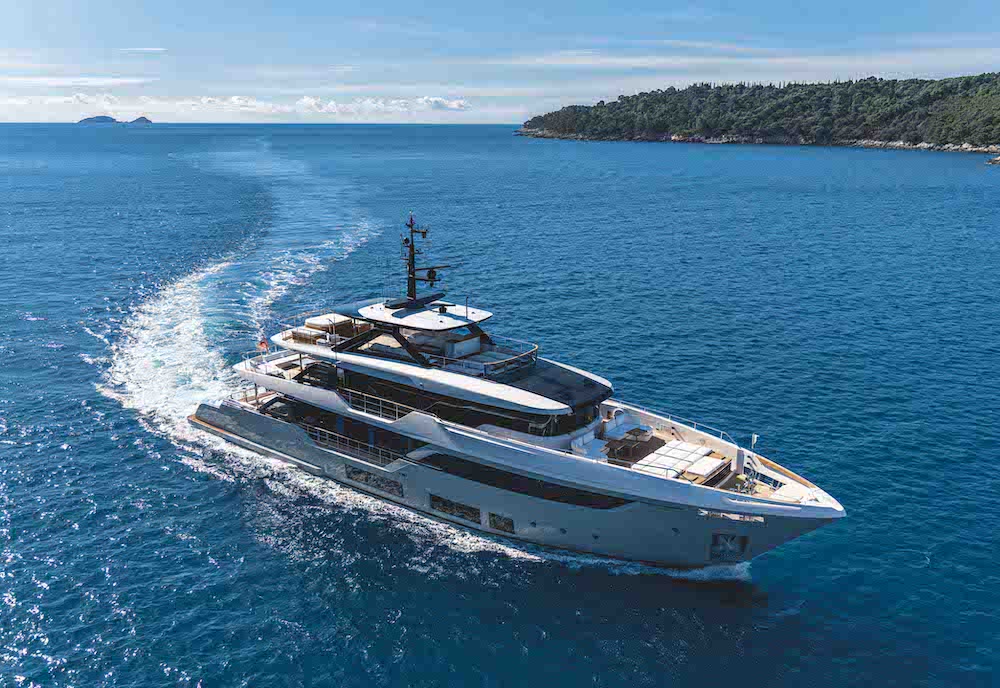
Moving up to the upper deck, guests have nearly 90 square meters at their disposal, divided between the outdoor lounges at the bow and stern, an indoor living area wrapped in floor-to-ceiling sliding glass doors on three sides, and the helm station. The sundeck is also impressively spacious, stretching 15 meters in length with a total surface of 65 square meters.
To put it into perspective, each of these areas could easily be a two- or three-room apartment on land. And on top of all this, there's the lower deck, which houses four double guest cabins plus the crew quarters.
A realm of space and natural light
For this entirely new project, the shipyard collaborated with Filippo Salvetti for the exterior design and ACPV Architects Antonio Citterio Patricia Viel for the interior layout and décor.
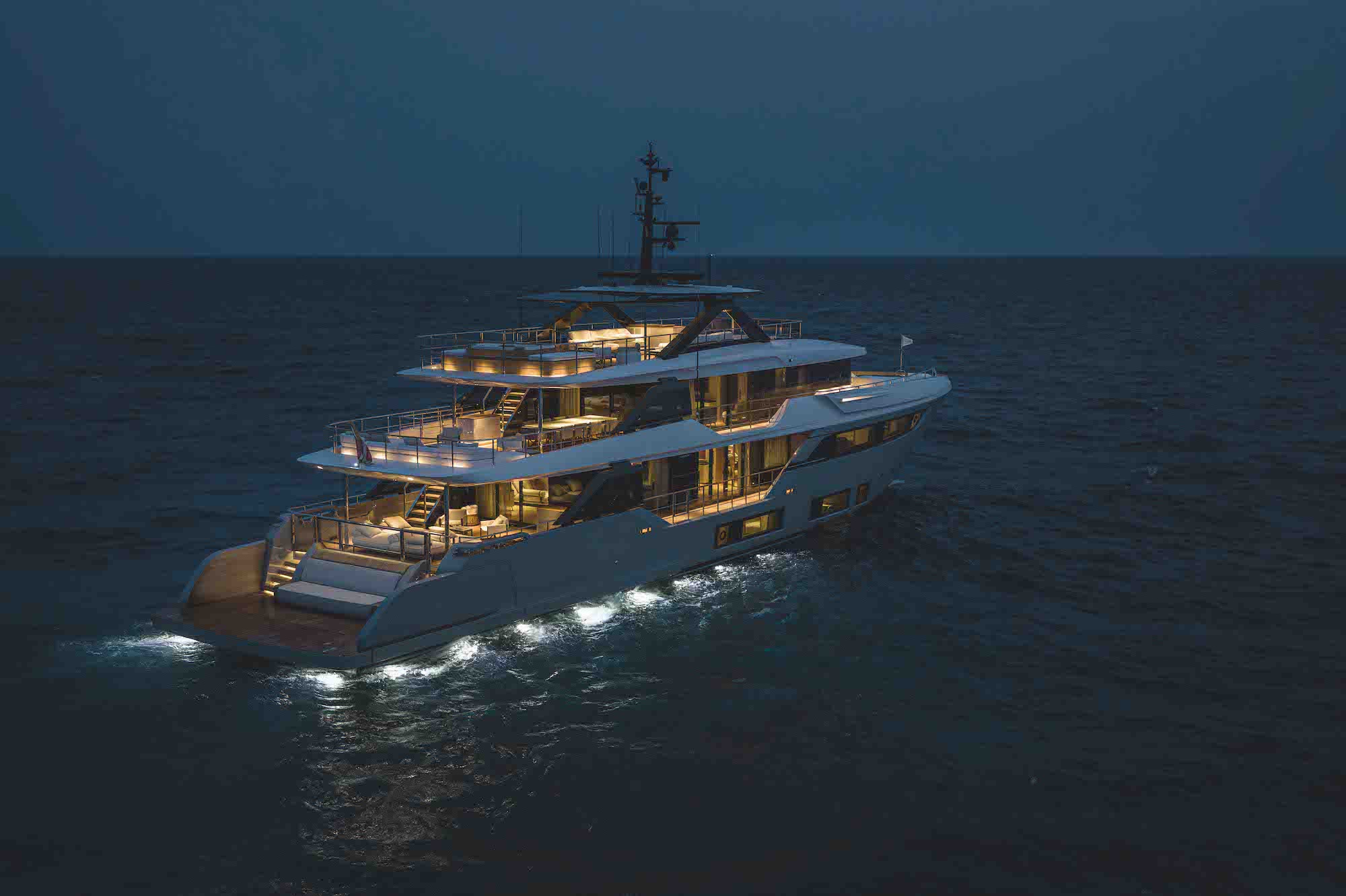
As soon as we climbed board Telli, the Custom Line Navetta 38, we headed straight to the salon—and what immediately struck us was the abundance of natural light. The floor-to-ceiling windows open on the sides as well, seamlessly blending indoor and outdoor spaces. Or perhaps it’s the other way around, depending on your perspective.
This sensation is even stronger in the panoramic salon on the upper deck, which is literally wrapped in sliding glass panels. Even the lower deck, typically more enclosed, benefits from impressive natural light, thanks to the large rectangular portholes that maximize brightness in the cabins.
The atmosphere on board is sophisticated—luxurious, yet never ostentatious. Custom freestanding furniture designed specifically for Telli, a neutral color palette, and natural materials such as teak, leather, linen, parchment, and raffia create a refined ambiance. Distinctive touches include oak slatted ceilings with a 3D effect. There are no sharp edges on board, only soft curves that honor traditional nautical design.
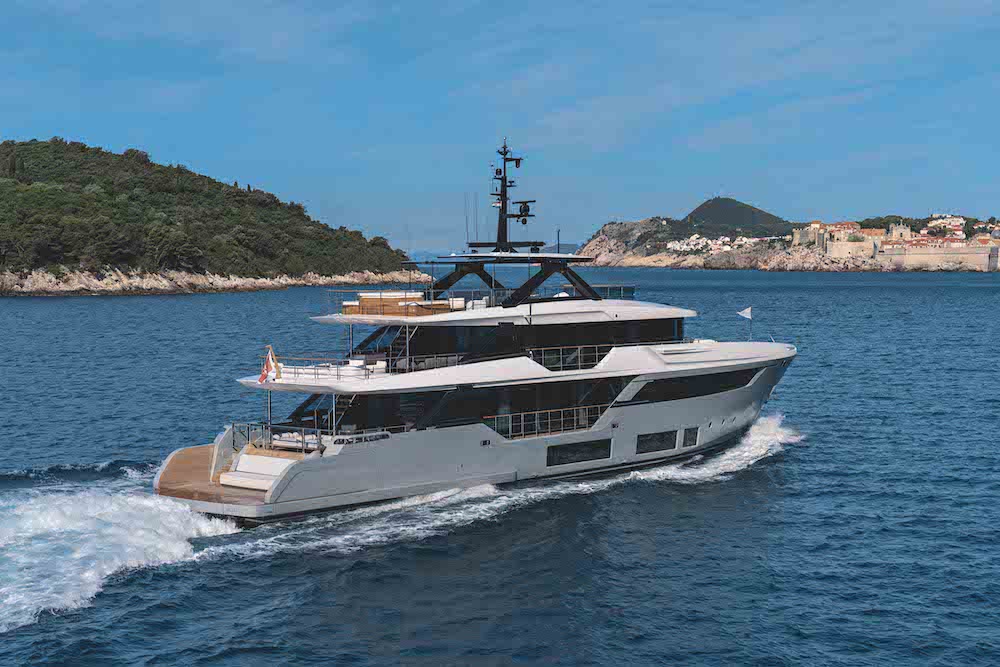
From the outside, Telli and its timeless lines integrate harmoniously with the sea, never overpowering it. Its light gray hull blends so seamlessly into the horizon that, from a distance, the yacht appears as a natural extension of the water itself.
Up close, this elegant color adds a dynamic touch to the yacht, while the dark tughino creates contrast and gives it a sportier look. Of course, the owner can personalize the color palette to his preference.
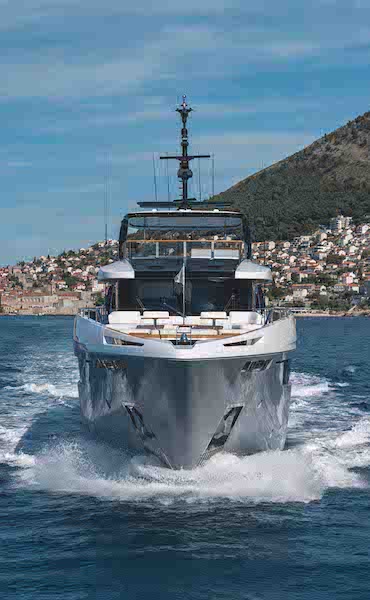
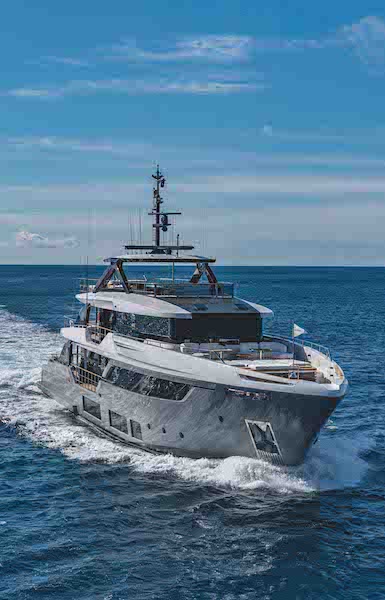
At first glance, the hull and superstructure lines appear simple, but a closer look at Telli reveals a series of striking details. The smooth, flowing surfaces are interrupted by bold elements—massive salon windows, a play of concave and convex shapes, sharp cuts, and alternating overhangs.
And then there's the stern—an area that perfectly embodies the Custom Line Navetta philosophy: these yachts must always stay seaworthy while embracing modernity. That’s why the stern remains enclosed and protected while underway but seamlessly opens to the sea once at anchor.
Read our article on the Custom Line Navetta 30-meter for more insights!
Custom Line Navetta 38: Propulsion
When it comes to propulsion, the Custom Line Navetta 38 is powered by two MAN engines, each delivering 1,400 hp, with shaft-line transmissions. This setup propels the 38-meter yacht, with a full-load displacement of 243,000 kg, to a top speed of 15 knots and an economical cruising speed of 10 knots, offering a range of approximately 2,800 nautical miles.
All of this, of course, comes with maximum stability, thanks to the combination of Naiad fin stabilizers and Seakeeper gyroscopic systems.
Specifications
| Length Overall | 38,76 m |
| Hull length | 38,66 m |
| Waterline length | 33,89 m |
| Beam | 8,00 m |
| Draft | 2,27 m |
| Light displacement | 202.000 kg |
| Full load displacement | 243.000 kg |
| Fuel tanks | 32.500 l |
| Water tanks | 4.000 l |
| Max people on board | 20 |
| Cabins for guests | 5 |
| Bathrooms | 7 |
| Cabins for crew | 4 |
| Bathrooms for crew | 4 |
| Engines | 2x1400 hp Man |
| Transmissions | Shaft line |
| Max speed | 15 knots |
| Fast cruising speed | 12 knots |
| Economic cruising speed | 10 knots |
| Autonomy in economic cruising speed | 2.800 nm |
Click here to enter in Custom Line's official website
There is no doubt that the future of recreational boating must be sustainable. As for the paths to follow, Yamaha remains open-minded, with investments in sustainable fuels and hydrogen.
What is clear is that Yamaha's commitment to electric outboard motors is growing stronger, as confirmed by the European launch of the new Yamaha Harmo 2.0, the latest version of the pioneering marine motor, which made its debut at Mets 2024 in Amsterdam.
The predecessor: Harmo 1.0
To better understand this second version, it’s helpful to review what Yamaha had already brought to market with the Harmo 1.0, which was unveiled at the Genoa Boat Show 2021.
The motor was characterized by the typical quietness of electric engines, the usual absence of emissions, as well as notable features like intuitive use, maneuverability, and reliability.
The innovations introduced by the new Yamaha Harmo 2.0
The electric engine presented by Yamaha Motor Europe in this second version introduces several interesting improvements. The goal here is to provide boaters with an even more versatile and easier navigation experience, catering to both experienced users and newcomers.
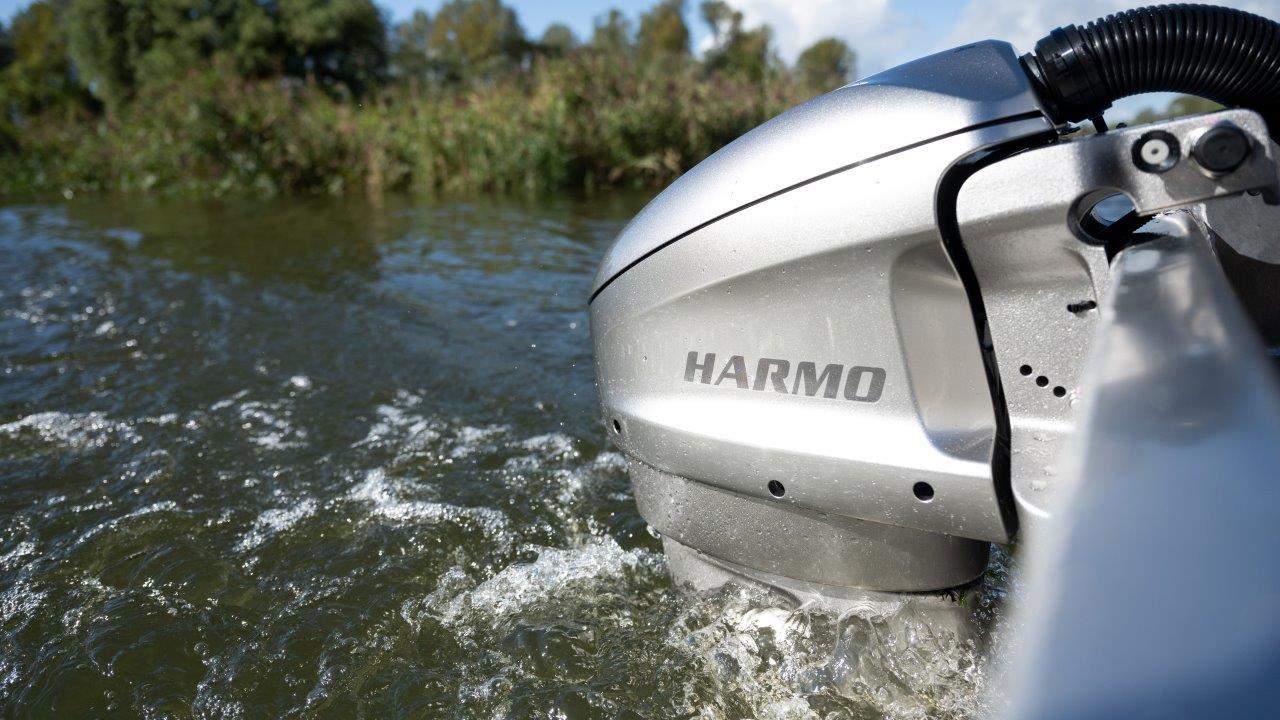
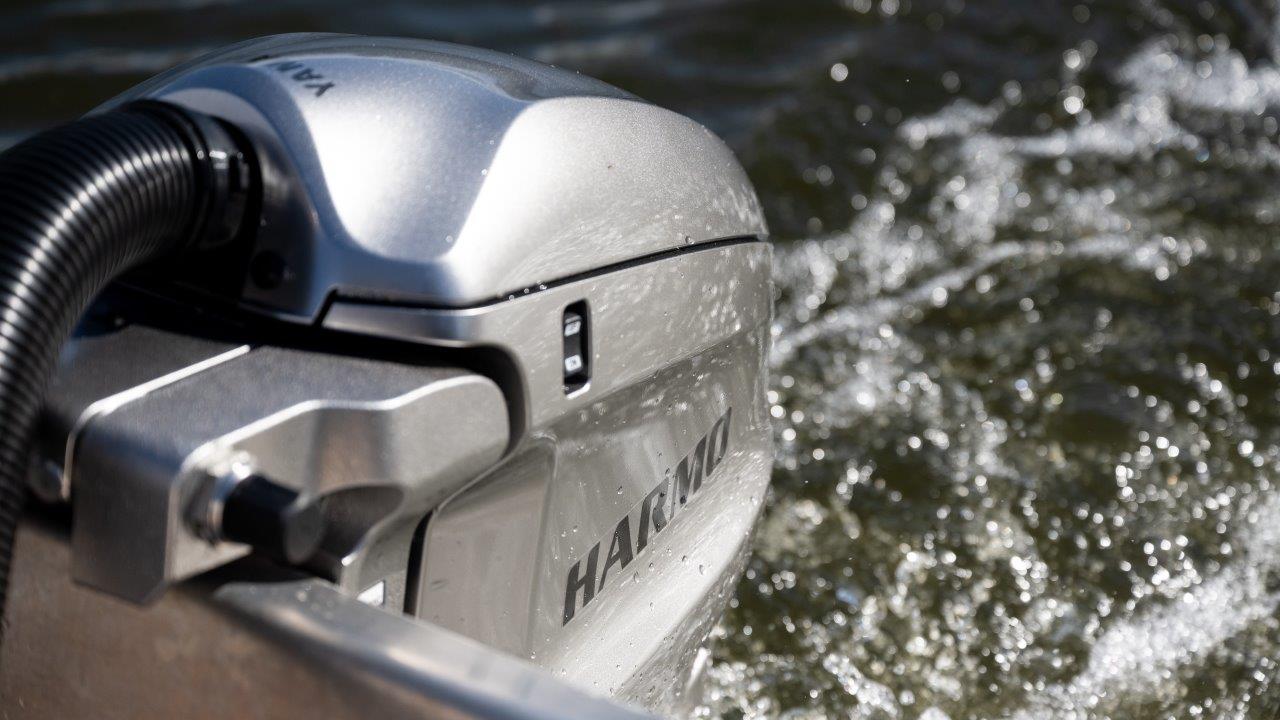
At first glance, the second model of Harmo features a more appealing design, but it's not just about aesthetics. There are also various configuration options available, along with a modular rigging system that, according to Yamaha's intentions, aims to overcome the typical limitations of electric propulsion in a marine environment.
Performance of Yamaha Harmo 2.0
Yamaha describes Harmo 2.0 as "powerful and silent." The ease and precision of movement – for example, during docking – are ensured by the rim-drive technology and Digital Electric Steering (DES), which provide immediate command responses.
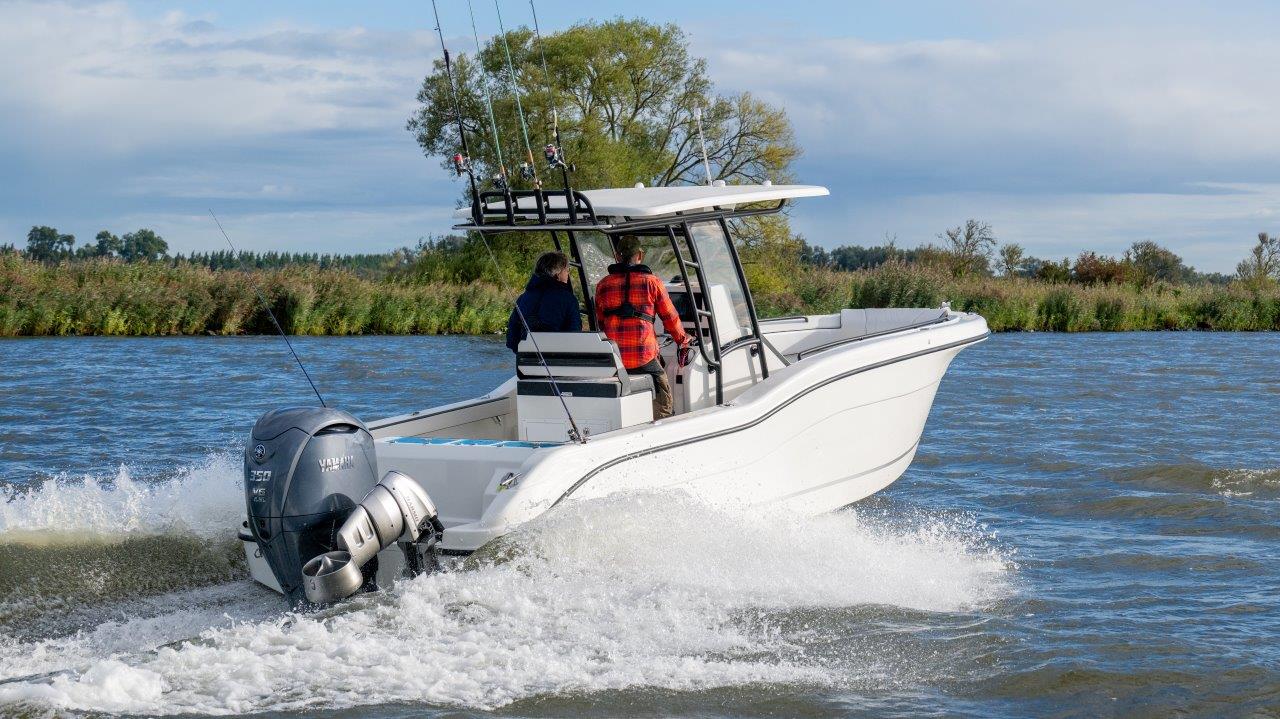
The minimal noise reduction is achieved, among other things, through the unique design of the motor, making it possible to navigate without disturbing wildlife and, at the same time, enjoying maximum relaxation.
Certainly, with its quiet operation, Yamaha Harmo 2.0 appeals to anglers, allowing them to approach the best fishing spots without scaring away their catch.
Joystick Control and integration options
Currently, at least in Europe, Yamaha Harmo 2.0 is only available in the full joystick configuration, both for single and dual installations. The promise here is stress-free maneuvering, even in the tightest spaces.
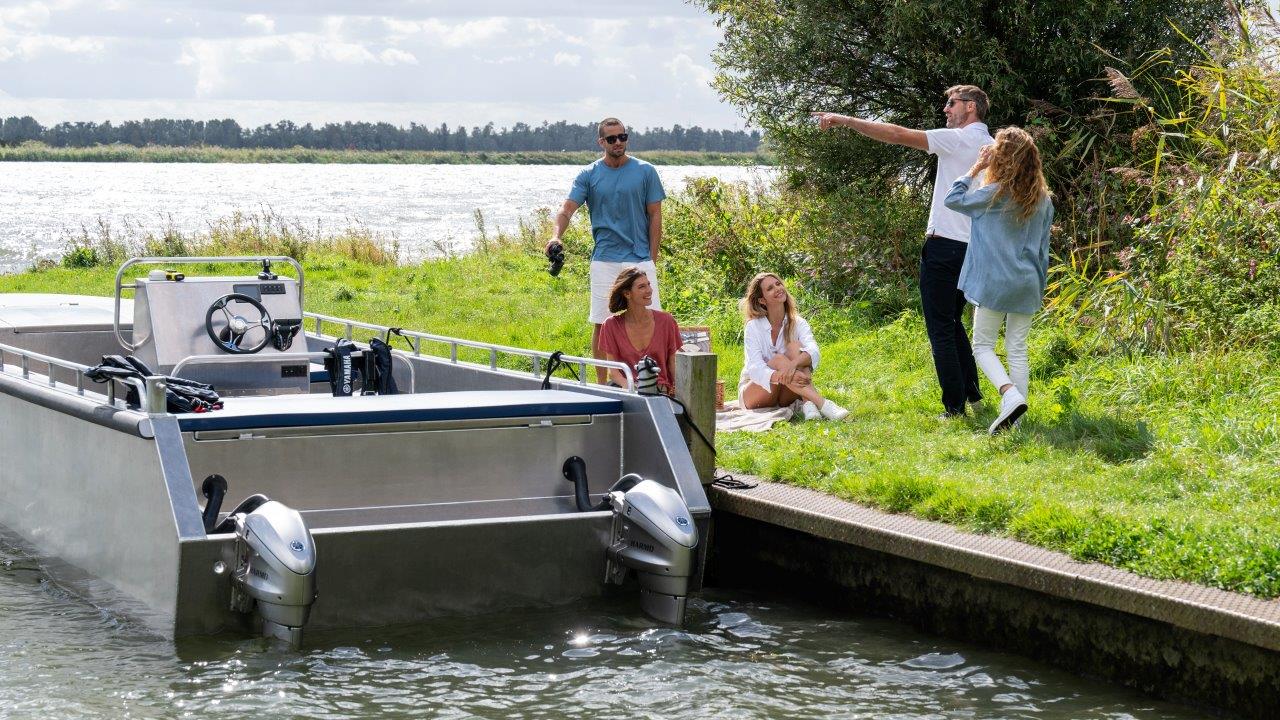
Tech-savvy boaters will certainly appreciate the ability to integrate the electric motor with Yamaha's HelmMaster EX system, a control system that offers many exciting features, all at the touch of a finger, to make boat handling even easier. By installing Harmo 2.0 at the stern, for example, it's possible to simplify navigation with the Autopilot function, or precisely reach a specific destination without error, and remain perfectly still with the SetPoint function, for which, once again, anglers will be particularly grateful.
Click and visit Yamaha Motor official website
On one side, we have Pirelli and its renowned maxi RIBs, which hardly need an introduction. On the other, there’s Mansory—a name that might sound unfamiliar to some but resonates strongly with high-end tuning enthusiasts. This famous German tuner has built its reputation by transforming supercars from brands like Bugatti, Porsche, Bentley, Ferrari, Lamborghini, and many more. From this union comes the Pirelli 50 Mansory Special Edition.
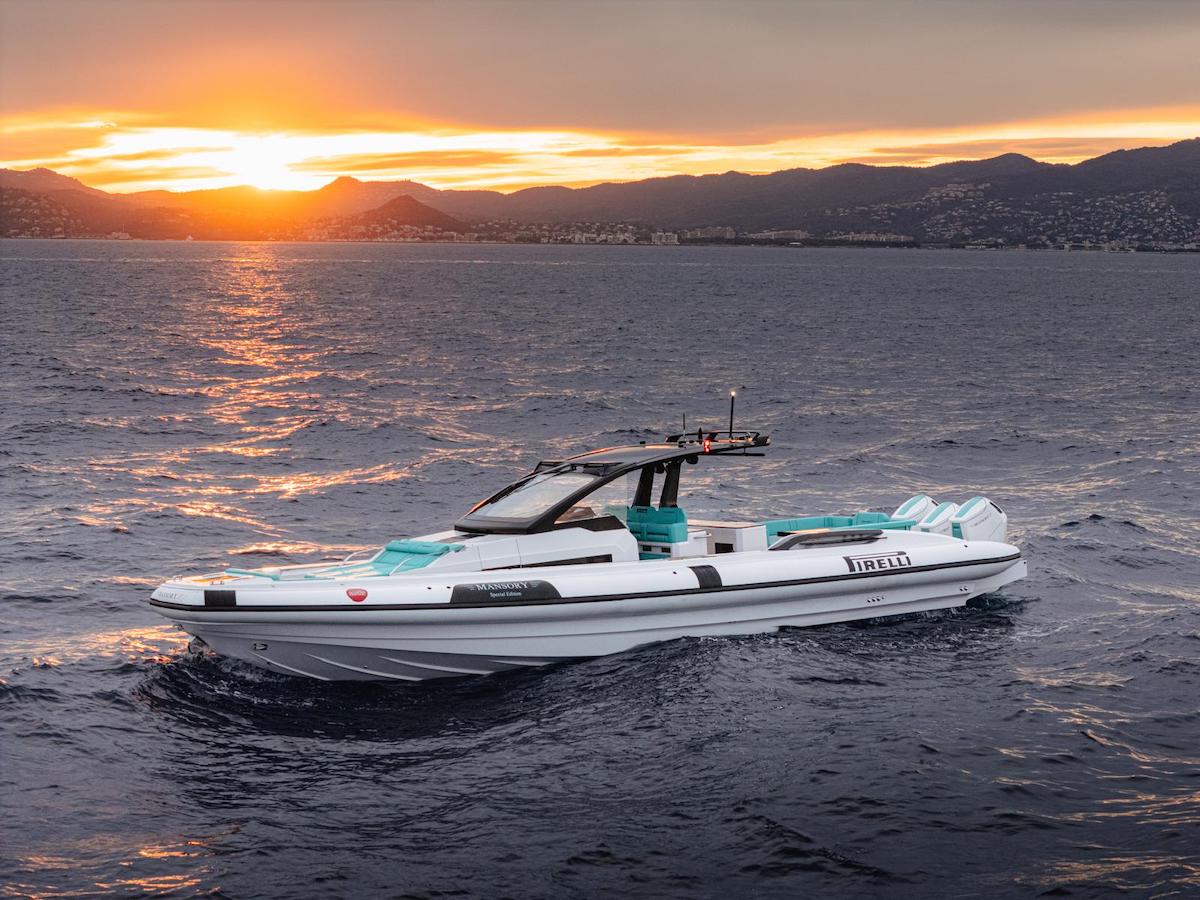
Mansory’s designers and engineers had already ventured beyond the automotive world into the realm of marine innovation with their customization of the Pirelli 42 (read more here), entering uncharted waters without missing a beat. Now, it’s the flagship of the Speedboats collection—designed for Pirelli by Mannerfelt Design Team—that takes center stage. A quick glance at the images of this roaring Special Edition reveals its dominant, assertive, and expert craftsmanship.
Exclusiviness aboard the Pirelli 50
The German tuning experts spared no effort, enhancing the flagship’s aesthetics, technology, and living spaces. From the deck to the windshield, the Teutonic touch is evident everywhere, with modifications ranging from subtle to substantial.
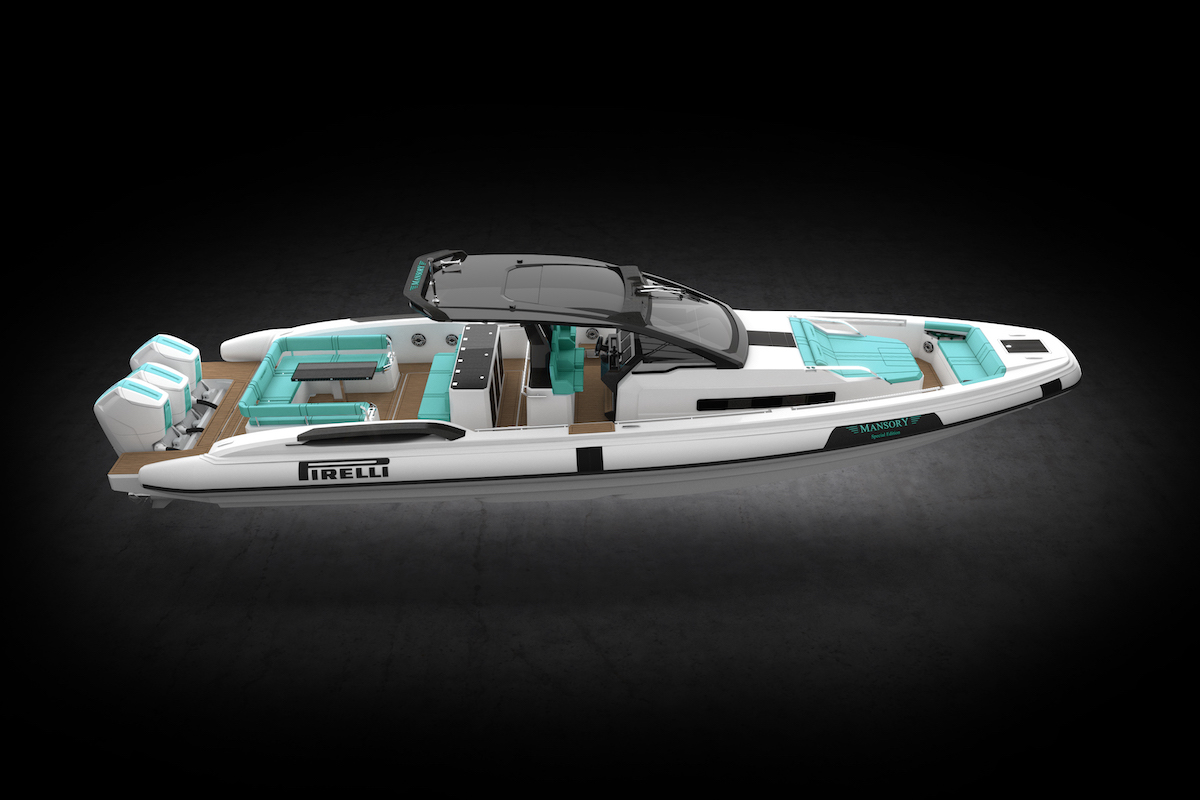
Let's try to summarize key upgrades. Let's start with the engine. While the original version recommended twin Mercury 600 HP engines, Mansory pushes the limits by adding a third 600 HP V12, delivering truly extraordinary performance.
The yacht's external appearance has been extensively reimagined with bespoke graphics and colors. Key highlights include Ice White tubes, Turquoise cushions, a Black hardtop, and tailored touches on the steering wheel, engines, and more. Mansory ensures that those aboard the Pirelli 50 Mansory Special Edition can enjoy a view of the sky even in covered areas. Whether it’s a clear blue sky or a starlit night, this effect has been skillfully recreated both in the cabin and under the hardtop.
A standout element of this special edition is the prominent use of exposed carbon fiber, which dominates key areas, including the helm station, spoiler, cockpit, air intakes, and even the speakers.
What's more, this new version introduces a foldable table—naturally crafted from carbon fiber—positioned between the aft seating, which seamlessly blends elegance with functionality.
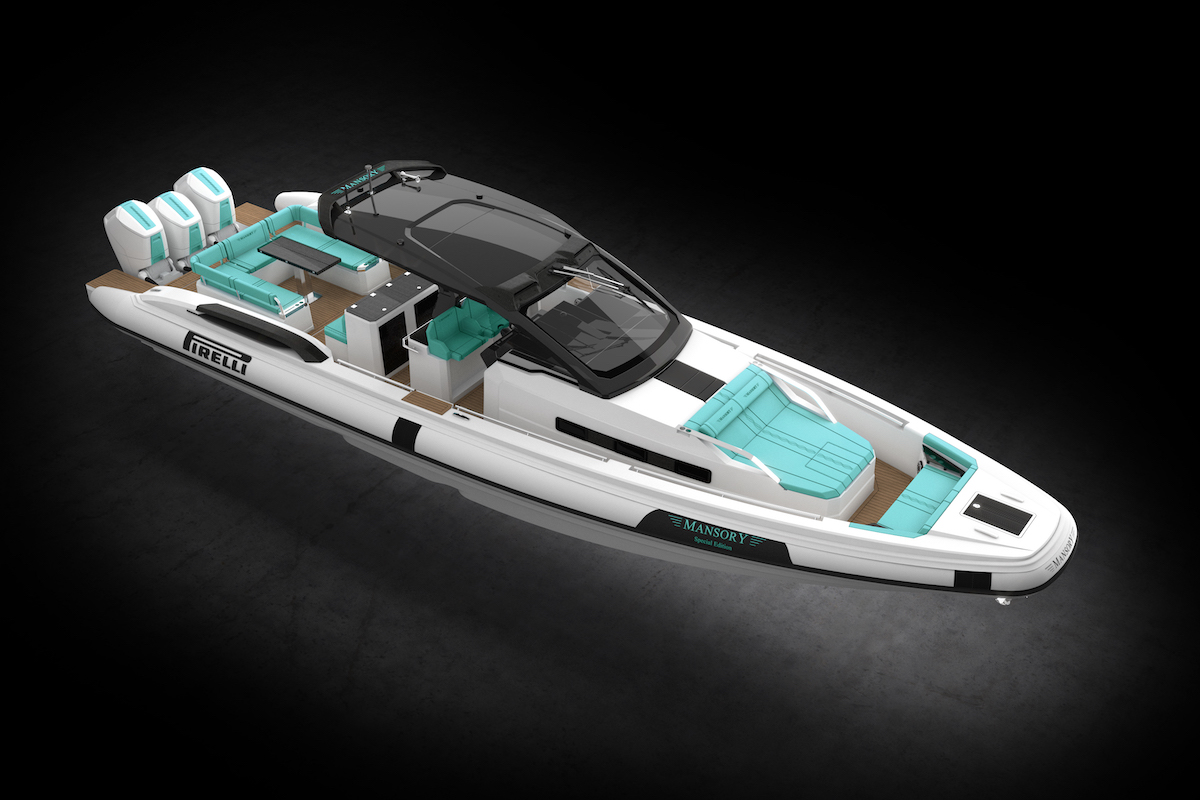
Pirelli 50 Mansory Special Edition: a new luxury concept
The attention to aesthetics is of the highest levels. Everything Mansory typically does for the world’s most prestigious automobiles has been masterfully applied to the Pirelli flagship. The result is a stylish maxi RIB with unparalleled personality.
Specifications
| Length overall | 15,20 m |
| Beam | 4,70 m |
| Tubular diameter | 0,60 m |
| Compartments | 8 |
| Fuel tank | 2000 l |
| Water tank | 285 l |
| Max people on board | 14 |
| Engines | 3x600 hp V12 Mercury OB |
| Project | Mannerfelt Design Team |
| Special Edition Tuning | Mansory |
Special Mansory Equipment
- Aerodynamic Roof Spoiler, crafted from exposed carbon fiber
- Hella Roof Lights: Two roof lights housed in exposed carbon fiber casings.
- Starry Light Integration
- Aviation-Inspired Start/Stop Button Cover
- Cockpit Control Panel: Finished in exposed carbon fiber
- Steering Wheel, Throttle, and Joystick: A luxurious combination of leather and exposed carbon fiber.
- Custom Speaker Covers: Tailored with exposed carbon fiber detailing.
- Wardrobe Door: Designed in exposed carbon fiber
- Rear Air Intake, made from exposed carbon fiber
- Custom Wall Panels: Personalized with exposed carbon fiber
- Foldable Rear Table, crafted from exposed carbon fiber.
- Cup Holders, made from exposed carbon fiber.
- Custom Cushions: Personalized with unique colors and Mansory logos
- Custom-Painted Engines
Click here to enter the official website of Pirelli Speedboats